User documentation ‹ 15. Wifi: from the radio to the ip stack › 17. Addresses, names, time
16. Switching: vlans, spanning tree, overlays
16.1. switching/vlan.py
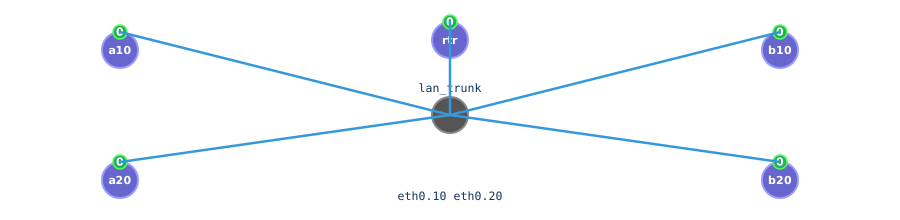
IEEE 802.1Q, ratified in 1998, puts four bytes inside the ethernet header: a tag protocol id 0x8100 where the ethertype used to be, and a 12-bit vlan id, so one wire carries up to 4094 separate networks. The first linux implementation was written by Ben Greear in 1999 and went into kernel 2.4 with its vconfig tool; the eth0.10 naming used here dates from it, and the ip link command of iproute2 has replaced vconfig since.
Today: every enterprise switch port is in a vlan; the same tag separates voice from data on a desk, tenants in a hosting rack and wifi networks on one access point cable.
Five containers on one lan, image trixie; addresses on eth0.10 and eth0.20, rtr on both:
cloonix cli nemo demo switching/vlan.py
cloonix cli nemo ssh a10 "ip link add link eth0 name eth0.10 type vlan id 10"
A vlan tag puts 0x8100 where the ethertype is read, so on the trunk every filter above the link layer matches nothing; the demo measures it:
cloonix cli nemo sniff a10 eth0 --dump icmp       nothing
cloonix cli nemo sniff a10 eth0 --dump            the tagged frames
16.2. switching/stp.py
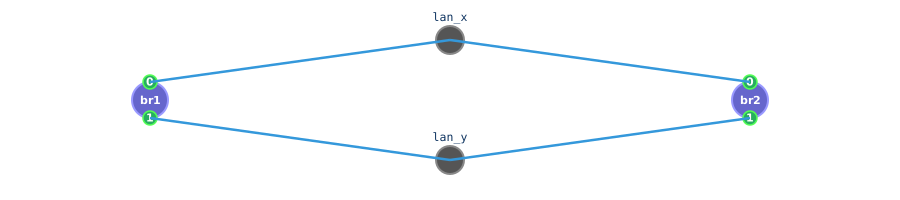
Spanning tree was written by Radia Perlman at Digital Equipment Corporation in 1985, in one afternoon by her own account, with a poem in the paper that states the algorithm in verse. Bridges elect a root, each keeps its cheapest path to it and blocks every other port, so a loop of wires becomes a tree without anybody drawing one. IEEE 802.1D adopted it in 1990; the rapid version, 802.1w, came in 2001 and is what the kernel runs today. The bridge under study is the one of the linux kernel, written by Lennert Buytenhek in 2000 for the 2.4 series, driven here with the bridge command of iproute2.
Today: every managed switch ships with spanning tree enabled, in its rapid form 802.1w since 2001; a second cable plugged between two office switches is the loop it silently removes.
Two containers each running a kernel bridge, two lans between them, image trixie: a loop. The demo keeps it unprotected for three seconds, counts the storm and ends it by taking a port down; then spanning tree elects a root and blocks one port, and the forwarding wire is cut under a ping:
cloonix cli nemo demo switching/stp.py
cloonix cli nemo ssh br1 "bridge link"
cloonix cli nemo sniff br1 eth0 --dump
16.3. switching/vxlan.py

VXLAN was written by VMware, Cisco, Arista and others and published as RFC 7348 in 2014, with Mallik Mahalingam and Dinesh Dutt among its authors. A data centre had run out of the 4094 VLAN tags of 802.1Q long before it ran out of tenants, and moving a virtual machine meant its layer 2 network had to follow it across routers. VXLAN answers both: a 24-bit identifier, sixteen million networks, and the frames wrapped in UDP so any routed IP fabric carries them unchanged. The linux side was written by Stephen Hemminger and David Stevens.
Today: VXLAN is the overlay of nearly every large data centre and of the public clouds, usually with EVPN, a BGP family, distributing the addresses in place of the flood-and-learn this demo shows. It is the transport OVN builds on, the subject of switching/ovn.py.
Five containers, three lans, image frr_trixie:
cloonix cli nemo demo switching/vxlan.py
Two sites on 10.0.0.0/24, joined by a routed core that does not carry that subnet. Each site has a VTEP; a vxlan interface, vni 100, wraps the site's frames in udp 4789 and sends them to the far VTEP across the core. The hosts believe they share one wire; the arp of one crosses the core as a unicast datagram to the other:
  cloonix cli nemo sniff vtep1 eth1 --dump udp port 4789
  cloonix cli nemo ssh vtep1 "bridge fdb show dev vxlan100"

Needs the vxlan module on the host, as kvm needs kvm_intel::

  sudo modprobe vxlan
16.4. switching/ovn.py
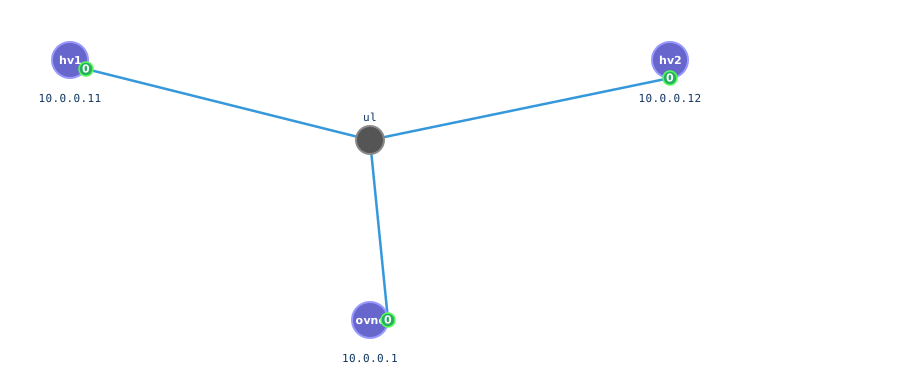
OVN, the Open Virtual Network, was started around 2015 by the Open vSwitch team, Ben Pfaff, Justin Pettit and others, to put a control plane on top of Open vSwitch: a logical network described once, in a northbound database, and realised across many hosts by a controller on each. It is the network layer under much of OpenStack and Kubernetes networking.
Three containers, one lan, image ovn_trixie:
cloonix cli nemo demo switching/ovn.py
One logical switch whose two ports land on different hypervisors, joined by a Geneve overlay so they share a layer-2 network with no cable between them; cut the underlay of one host and the overlay goes with it:
cloonix cli nemo ssh ovnc "ovn-nbctl show"
cloonix cli nemo sniff hv1 eth0 --dump udp port 6081
User documentation ‹ 15. Wifi: from the radio to the ip stack › 17. Addresses, names, time