User documentation ‹ 16. Switching: vlans, spanning tree, overlays › 18. Routing
17. Addresses, names, time
17.1. address/dhcp.py
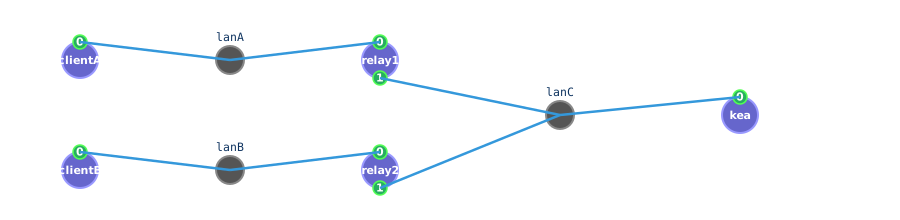
BOOTP, RFC 951 by Bill Croft and John Gilmore in 1985, let a diskless machine ask the network who it was. DHCP, written by Ralph Droms as RFC 1531 in 1993 and settled in RFC 2131 in 1997, kept the packet format and added leases and a pool: the four messages seen here, DISCOVER, OFFER, REQUEST, ACK, and the giaddr field a relay fills in. Kea is the Internet Systems Consortium server of 2014, the successor of the ISC dhcpd that Ted Lemon had maintained since the 1990s. dnsmasq is the work of Simon Kelley, published in 2001 for home routers; dhcpcd is by Roy Marples, and udhcpc belongs to busybox.
Today: every home router, campus and cloud network hands out addresses with it; a phone joining a wifi gets address, gateway and resolver in four packets, and the relay shown here is what lets one server serve hundreds of lans.
Five containers, three lans, image dhcp_trixie: kea, dnsmasq as the relay, dhcpcd and busybox udhcpc as clients:
cloonix cli nemo demo address/dhcp.py
Both clients start with no address. The relay writes its own address in giaddr and forwards the broadcast as a unicast; kea picks the pool on that field. One exchange seen at the client lan, at the relay and at the server:
t+ms  seen on             from                to                  what it said
0     clientA eth0  lanA  0.0.0.0:68          255.255.255.255:67  DISCOVER giaddr=0.0.0.0
3     relay1 eth1  lanC   10.1.0.1:67         10.0.0.3:67         DISCOVER giaddr=10.1.0.1
9     kea    eth0  lanC   10.0.0.3:67         10.1.0.1:67         OFFER    yiaddr=10.1.0.100
12    clientA eth0  lanA  10.1.0.1:67         255.255.255.255:68  OFFER    yiaddr=10.1.0.100
The two client programs get different addresses on the same mac: option 61, the client identifier. To break: ip route del 10.1.0.0/24 on kea; the server answers giaddr and the offer is dropped while the log says it was sent:
cloonix cli nemo sniff relay1 eth1 --dump "udp port 67 or udp port 68"
17.2. address/ipv6.py

IPv6 was specified in RFC 1883 in 1995 by Steve Deering and Robert Hinden, when the end of the 32-bit IPv4 address space was already in sight: 128-bit addresses, no broadcast, no arp. Stateless autoconfiguration, RFC 1971 in 1996 by Susan Thomson and Thomas Narten, now RFC 4862, lets a host build its own address from a prefix the router announces, with no server keeping a lease. The KAME project in Japan wrote the stack of the BSDs; Pedro Roque wrote the first one of linux, and the USAGI project of Hideaki Yoshifuji completed it.
Today: more than forty percent of the traffic reaching Google arrives over IPv6, and several mobile networks hand out nothing else. The router side is zebra, of frr, the descendant of GNU Zebra written by Kunihiro Ishiguro.
Three containers, two lans, image frr_trixie:
cloonix cli nemo demo address/ipv6.py
r1 holds ::1 of a prefix on each lan and runs zebra, which sends router advertisements. The hosts are given no address: each has a link-local one, fe80::, made from its mac, then makes a global one from the prefix it hears and takes r1, by its link-local address, as default router. h1 pings the address h2 made. All of it is icmp6:
cloonix cli nemo sniff r1 eth0 --dump icmp6
cloonix cli nemo ssh r1 "vtysh -c 'show interface eth0'"
cloonix cli nemo ssh h1 "ip -6 neigh show dev eth0"
17.3. address/dns.py

Until 1983 every host on the ARPANET fetched one HOSTS.TXT file from SRI. Paul Mockapetris designed the Domain Name System that year, RFC 882 and 883, rewritten as RFC 1034 and 1035 in 1987: a tree of names, delegated zone by zone, and resolvers that ask, cache and forward. BIND, the Berkeley Internet Name Domain, was written at the University of California in 1984 by Douglas Terry, Mark Painter, David Riggle and Songnian Zhou, maintained by Paul Vixie from 1988, and rewritten as BIND 9 in 2000 by the Internet Systems Consortium, which still publishes it.
Today: every connection on the internet starts with a DNS query. BIND serves a large share of the authoritative zones and several root servers, and the zone file format it introduced is the one every other server reads.
Five containers, four lans, image dns_trixie (bind9 and frr):
cloonix cli nemo demo address/dns.py
Both resolvers forward to 10.255.0.3, a loopback of dnstop announced by ospf. Every interface of the path is sniffed and the dns messages printed in one time-ordered table; the second query is answered from the cache with lanC silent. The servers need ip_forward=1, which the demo sets:
cloonix cli nemo ssh dns1 "ip link set eth1 down"      the name stops resolving
cloonix cli nemo sniff dns1 eth1 --dump udp port 53
17.4. address/unbound.py
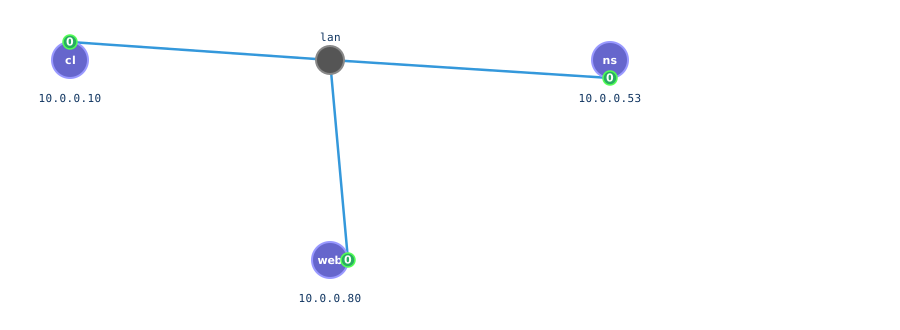
Unbound was written by NLnet Labs, first released in 2008, with Wouter Wijngaards as its main author: a validating, recursive, caching resolver, the piece that turns a name into an address for a client, checks DNSSEC as it goes, and remembers what it learnt. It was built as a clean, security-minded alternative to BIND for the resolver job.
Today: Unbound is the default resolver of FreeBSD and OpenBSD, sits in pfSense, OPNsense and Pi-hole setups, and answers for large public resolvers; validating DNSSEC at the resolver is its usual role.
Three containers, one lan, image unbound_trixie:
cloonix cli nemo demo address/unbound.py
The resolver, authoritative for one small local zone, answers a name, serves the repeat from cache, and refuses a name it does not hold rather than inventing one; the client then reaches the address it was given:
cloonix cli nemo ssh cl "dig @10.0.0.53 www.shop.test"
cloonix cli nemo sniff ns eth0 --dump udp port 53
17.5. address/knot.py
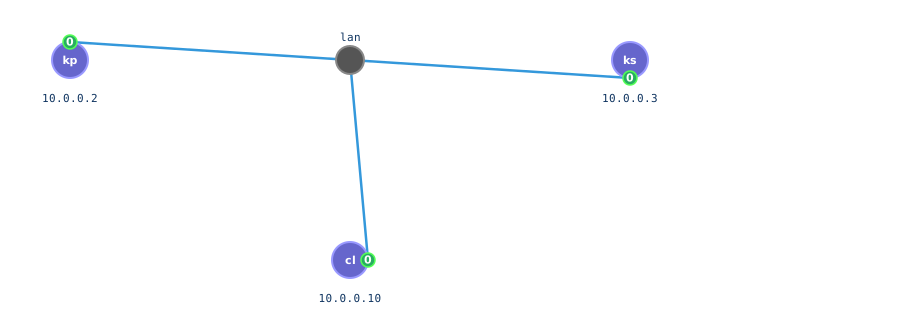
Knot DNS is made by CZ.NIC, the Czech domain registry, the same house as the BIRD routing daemon, with a first release around 2011. It is an authoritative-only server: its job is to hold zones and answer for them, not to resolve on a client's behalf, and CZ.NIC runs it for the .cz top-level domain.
Today: Knot DNS serves the .cz zone and several other top-level domains and runs on some root server instances; notify and transfer, shown here, are how any zone with more than one server stays identical on all of them.
Three containers, one lan, image knot_trixie:
cloonix cli nemo demo address/knot.py
A primary is given the zone; it notifies a secondary, the secondary transfers the whole zone across, and from then on both answer the same data. A lookup is UDP 53; the transfer is TCP 53:
cloonix cli nemo ssh cl "kdig @10.0.0.3 www.shop.test"
cloonix cli nemo sniff kp eth0 --dump tcp port 53
17.6. address/ntp.py

chrony was started by Richard Curnow in 1997 and is now maintained mainly by Miroslav Lichvar at Red Hat. It implements NTP, the Network Time Protocol whose design goes back to David Mills in the 1980s, and was written to keep good time on machines that are not always connected and whose clocks drift. It is the default time daemon on most linux distributions.
Today: chrony is the default time daemon of Red Hat, Fedora, SUSE and Ubuntu server; a virtual machine that pauses and resumes, or a laptop that sleeps, is the case it was written for.
Two containers, one lan, image ntp_trixie:
cloonix cli nemo demo address/ntp.py
The server offers its own clock as a stratum-8 source; the client finds it, marks it reachable and follows it. chronyd runs with -x: the clock of a container is its host's and not its to set. NTP is one small request and reply on UDP 123:
cloonix cli nemo ssh ntpc "chronyc -n sources -v"
cloonix cli nemo sniff ntps eth0 --dump udp port 123
User documentation ‹ 16. Switching: vlans, spanning tree, overlays › 18. Routing