User documentation ‹ 17. Addresses, names, time › 19. Encryption, tunnels, filtering
18. Routing
18.1. routing/frrspider.py and frrspider_bgp.py
OSPF was designed by John Moy for the Internet Engineering Task Force, first published as RFC 1131 in 1989 and settled as OSPFv2 in RFC 2328 in 1998, as an open replacement for RIP: every router floods what it sees, every router holds the same map and runs Dijkstra's shortest path algorithm of 1956 on it. FRRouting descends from GNU Zebra, begun by Kunihiro Ishiguro in 1996, continued as Quagga from 2002 and forked as FRR in 2017 under the Linux Foundation; vtysh, the cisco-like shell used below, comes from Zebra.
Today: OSPF is the interior protocol of most enterprise and campus networks; FRR runs in data-centre switches (SONiC, Cumulus), in cloud routers and in the routing of many Kubernetes clusters.
BGP was sketched by Kirk Lougheed of Cisco and Yakov Rekhter of IBM at an IETF meeting in January 1989, on napkins by legend, and published as RFC 1105 the same year; BGP-4 of 1994 still runs the internet. Every network is an autonomous system, and a router tells its neighbours which prefixes it can reach and through which systems the path goes. Using it between the switches of one data centre, one AS per switch, was described by Petr Lapukhov in RFC 7938 in 2016.
Today: BGP holds the internet together, close to a million IPv4 prefixes exchanged between some seventy-five thousand autonomous systems, and the same protocol runs inside data centres between racks.
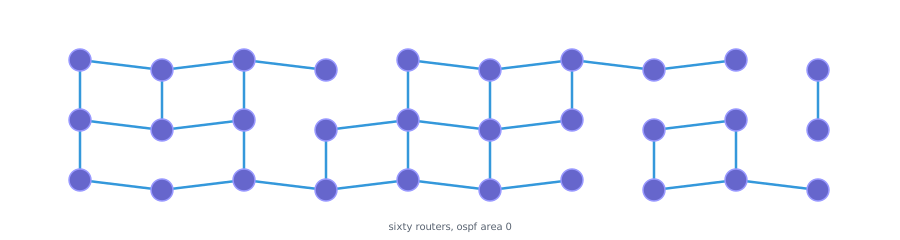
Sixty routers in a web, image frr_trixie, configured in parallel:
cloonix cli nemo demo routing/frrspider.py
cloonix cli nemo ssh tod1 vtysh -c "show ip ospf neighbor"
frrspider_bgp.py is the same sixty, each its own autonomous system peering with its neighbours, 280 sessions:
cloonix cli nemo demo routing/frrspider_bgp.py
cloonix cli nemo ssh tod1 vtysh -c "show bgp summary"
The demo asks for containers with no init and checks the count with dump commands after the creation loop:
the server has 59 of the 60 containers. Missing: nod22
18.2. routing/frrmix.py
Two protocols with two authors. OSPF, John Moy, RFC 1131 in 1989: an interior protocol where every router holds the map of its own network. BGP, Kirk Lougheed and Yakov Rekhter, RFC 1105 the same year: an exterior protocol where an autonomous system tells the next what it can reach and nothing more. The split is the architecture of the internet since the early 1990s. FRRouting runs both in one process family, descended from GNU Zebra begun by Kunihiro Ishiguro in 1996, Quagga from 2002, forked as FRR in 2017 under the Linux Foundation.
Today: the pair shown here is the usual shape of a real network: an interior protocol inside each site, BGP between sites and toward providers, and redistribution at the border.
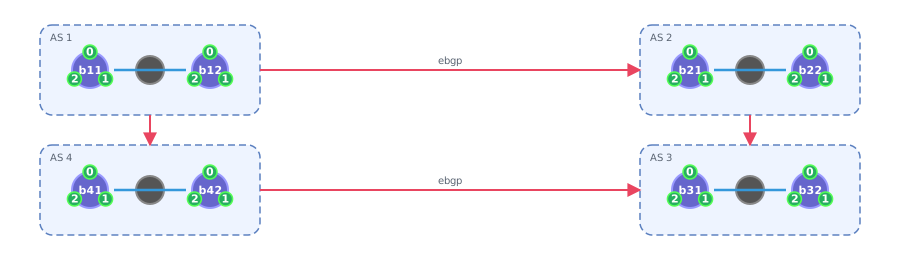
Four autonomous systems in a ring, four routers each: ospf inside, ebgp between the borders, ibgp between the two borders of an AS over their loopbacks:
cloonix cli nemo demo routing/frrmix.py
cloonix cli nemo ssh i41 ping -c 3 10.1.0.1
Five pieces, each load bearing: loopbacks advertised into ospf, ibgp on the loopback, next-hop-self on the borders, a default originated into ospf, and ip route 10.n.0.0/16 blackhole so the aggregate is real. Remove one and every session is up and carries nothing. NB_AS at the top of the script is the size knob:
cloonix cli nemo sniff b12 eth2 --dump tcp port 179
18.3. routing/bird.py

BIRD, the BIRD Internet Routing Daemon, has been developed at CZ.NIC since 1998, led for years by Ondrej Filip and Martin Mares. It is one of the two open routing daemons carrying real internet routes at scale: many route servers at internet exchanges run BIRD. Where frr descends from Zebra and mimics a vendor's command line, BIRD has a configuration language of its own.
Today: BIRD is the route server of most large internet exchange points, DE- CIX, AMS-IX and LINX among them, where one daemon holds hundreds of BGP sessions and millions of paths.
Seven containers, four lans, image bird_trixie:
cloonix cli nemo demo routing/bird.py
Three BIRD routers in a line speak OSPF, the same protocol frr speaks in the routing/frr demos, so hA reaches hB across three hops none was told about; cut the middle link and the far side goes away, proving the route was OSPF's:
cloonix cli nemo ssh r2 "birdc show route"
cloonix cli nemo sniff r1 eth1 --dump "ip and not udp and not tcp"
18.4. routing/isis.py
IS-IS was written at Digital Equipment Corporation in the 1980s for DECnet Phase V, largely by Radia Perlman and Dave Oran, and became the ISO standard 10589 for the OSI protocols. RFC 1195, by Ross Callon in 1990, taught it to carry IP routes. The OSI network layer it was made for disappeared; the routing protocol stayed, because it runs beside IP and not over it, and carrying a new address family, IPv6 then MPLS labels, took a new field and no new protocol.
Today: IS-IS is the interior protocol of most large carriers and of many data centre fabrics, where OSPF holds the enterprise. The daemon here is isisd of frr.
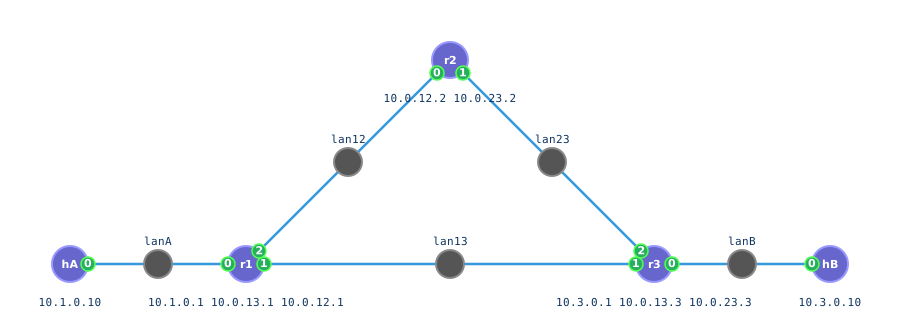
Five containers, five lans, image frr_trixie:
cloonix cli nemo demo routing/isis.py
Three routers in a triangle, a host behind r1 and one behind r3. The direct side costs 10 and carries the traffic; it is cut, the link states are flooded, the traffic goes through r2; it is restored and taken again. IS-IS frames carry no IP header, the filter reaches them by exclusion:
cloonix cli nemo ssh r1 "vtysh -c 'show isis neighbor'"
cloonix cli nemo ssh r2 "vtysh -c 'show isis database'"
cloonix cli nemo sniff r1 eth2 --dump "not ip and not ip6 and not arp"
18.5. routing/babel.py
Babel was designed by Juliusz Chroboczek around 2007, standardised as RFC 6126 and later RFC 8966. It is a distance-vector protocol, like the old RIP, but built to be loop-free and to work over links that appear, vanish and vary in quality, wireless meshes especially. Where OSPF floods a full map, Babel keeps only distances and reasons about them carefully enough never to loop.
Today: Babel routes community mesh networks and is the routing protocol of the IETF Homenet architecture; it ships in OpenWrt as babeld and inside BIRD and FRR.
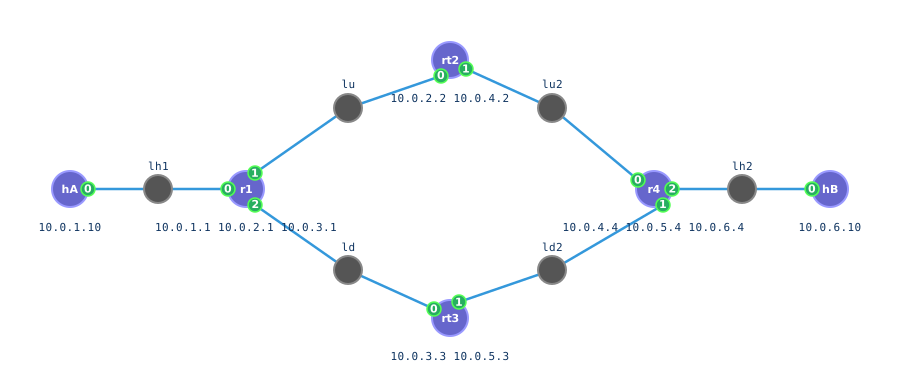
Six containers, five lans, image babel_trixie:
cloonix cli nemo demo routing/babel.py
A diamond with two disjoint paths: Babel picks one, and when it is cut moves to the other with no static route and no operator. It speaks UDP 6696:
cloonix cli nemo ssh r1 "ip route"
cloonix cli nemo sniff r4 eth0 --dump udp port 6696
18.6. routing/batman.py

B.A.T.M.A.N., Better Approach To Mobile Ad-hoc Networking, came out of the Freifunk community wireless movement in Germany around 2006. Its advanced form, batman-adv, moved the whole protocol into the linux kernel and down to layer 2: the mesh carries ethernet frames, so anything above runs across it none the wiser. It is maintained with the kernel by the Open-Mesh project.
Today: batman-adv carries the Freifunk city meshes of Germany, with tens of thousands of nodes, and is part of the mainline kernel since 2.6.38; OpenWrt routers run it unchanged.
Four containers, three lans, image batman_trixie:
cloonix cli nemo demo routing/batman.py
Four nodes in a chain reach each other over one interface, bat0, though no node is cabled to more than two others; take the middle out and the chain splits. The OGMs it floods use ethertype 0x4305, with no IP in them:
cloonix cli nemo ssh n1 "batctl o"
cloonix cli nemo sniff n2 eth0 --dump
User documentation ‹ 17. Addresses, names, time › 19. Encryption, tunnels, filtering