User documentation ‹ 18. Routing › 20. Services and availability
19. Encryption, tunnels, filtering
19.1. security/tls.py

SSL was written at Netscape in 1994 by Taher Elgamal and his team so that a card number could be typed into a browser; SSL 3.0, by Paul Kocher, Phil Karlton and Alan Freier in 1996, is the design everything after it kept. The IETF renamed it TLS in 1999. Eric Young and Tim Hudson wrote SSLeay in Australia from 1995, a free implementation outside the export rules of the United States; in 1998 it became OpenSSL. TLS 1.3, RFC 8446 by Eric Rescorla in 2018, removed every old cipher and encrypts the certificate itself.
Today: OpenSSL is in nearly every server of the internet, and more than nine pages out of ten load over https, a share that Let's Encrypt, giving certificates for free since 2015, took from under a half.
Two containers, one lan, image openvpn_trixie, used for its openssl, curl and python3:
cloonix cli nemo demo security/tls.py
web makes a key and a self-signed certificate with openssl and serves one page on port 8080 in http and on port 8443 in https. The demo keeps the bytes caught on web 0 during each fetch and looks for the string of the page: present on 8080, absent on 8443. The client then fetches trusting another certificate, one it made itself, and curl refuses, exit 60:
cloonix cli nemo sniff web eth0 --dump tcp port 8080
cloonix cli nemo sniff web eth0 --dump tcp port 8443
cloonix cli nemo ssh client "openssl s_client -connect 10.0.0.2:8443 </dev/null"
19.2. security/wg.py

WireGuard was written by Jason A. Donenfeld and published in 2016, and merged into linux 5.6 in March 2020 after Linus Torvalds called its few thousand lines a work of art next to the ipsec code. It negotiates nothing: one key exchange from the Noise framework of Trevor Perrin, Curve25519 by Daniel J. Bernstein, ChaCha20-Poly1305 for the data, and a peer is a public key with a list of allowed addresses. The 1-RTT handshake caught below is the whole protocol.
Today: WireGuard is in the linux, windows, macos, ios and android of commercial VPN providers, in Tailscale and Netbird meshes and in kubernetes network plugins; its code is about four thousand lines, where IPsec stacks count hundreds of thousands.
Four containers, three lans, image wg_trixie:
cloonix cli nemo demo security/wg.py
The same fetch three times: without a tunnel, the string served by hostB is readable on all three wires; with it, lanC carries wireguard data packets and the string is searched for in the raw bytes and found on lanA and lanB only. Nothing changed on the hosts:
cloonix cli nemo sniff gwA eth1 --dump udp port 51820
19.3. security/openvpn.py

OpenVPN was written by James Yonan and first released in 2001. It runs entirely in user space on top of a tun device and uses OpenSSL for its cryptography; on the wire it is one UDP flow, which crosses NAT and firewalls as any other. For two decades it was the default do-it-yourself VPN before WireGuard; the wg demo in this area is the modern comparison.
Two containers, one lan, image openvpn_trixie:
cloonix cli nemo demo security/openvpn.py
Its simplest mode, one pre-shared static key and two peers: a private 10.8.0.0/24 rides inside a single UDP flow on port 1194, and the ping over it is not readable on the underlay:
cloonix cli nemo ssh ovs "ip addr show tun0"
cloonix cli nemo sniff ovs eth0 --dump udp port 1194
19.4. security/tinc.py

tinc was started by Guus Sliepen and Ivo Timmermans in the late 1990s. Its distinctive idea is the automatic full mesh: tell each node how to reach one or two others and tinc works out direct paths between every pair, routing around a node that goes down: a peer-to-peer VPN, where a classic OpenVPN server is a hub with spokes.
Today: tinc links small fleets of servers and home networks where no node can be the hub; its mesh idea is the one later tools such as ZeroTier, Nebula and Tailscale built products on.
Two containers, one lan, image tinc_trixie:
cloonix cli nemo demo security/tinc.py
Each node has a host file with its public key; the nodes exchange them and connect, and the ping over the VPN rides port 655 while staying off the wire in clear:
cloonix cli nemo ssh na "ping -c3 10.9.0.2"
cloonix cli nemo sniff na eth0 --dump port 655
19.5. security/ipsec.py

IPsec is the IETF standard for encryption at the IP layer, RFC 4301 with the IKEv2 key exchange in RFC 7296. Two long-lived open stacks implement it on linux: strongSwan, led by Andreas Steffen, and Libreswan, led by Paul Wouters and shipped by Red Hat. They are separate code bases that must agree on the wire: pairing them tests the standard, not one code base.
Today: IPsec carries most site-to-site VPNs between companies and cloud providers, the voice of 4G and 5G phones toward their operator (VoWiFi), and the IKEv2 client built into windows, macos, ios and android.
Two containers, one lan, images strongswan_trixie and libreswan_trixie:
cloonix cli nemo demo security/ipsec.py
strongSwan on one gateway and Libreswan on the other agree on IKEv2 and a shared secret, then carry the ping between them as ESP, IP protocol 50; the ICMP inside is no longer readable on the wire:
cloonix cli nemo ssh gwA "swanctl --list-sas"
cloonix cli nemo sniff gwA eth0 --dump "ip and not tcp and not udp and not icmp"
19.6. security/nftables.py
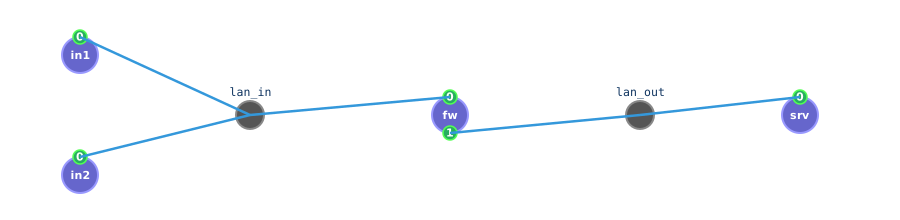
Packet filtering in linux was rewritten three times by the same community: ipfwadm, then ipchains by Rusty Russell in 1998, then the netfilter framework and iptables, by Rusty Russell and Harald Welte, in kernel 2.4 of 2000. nftables is the fourth: Patrick McHardy presented it in 2008 as one virtual machine in the kernel replacing the separate ip, ip6, arp and ethernet tables, it was merged in kernel 3.13 in January 2014, and Pablo Neira Ayuso leads the netfilter project that maintains it. Connection tracking, the state seen here, dates from the iptables generation.
Today: nftables is the default packet filter of Debian, Ubuntu, Fedora and RHEL; firewalld, docker and kubernetes rules end up in it, and the iptables command of those systems is a translator to it.
Four containers, two lans, image nft_trixie:
cloonix cli nemo demo security/nftables.py
A stateful filter, masquerade of the private range, a dnat that picks one of two inside hosts, named counters saying which rule matched, and a connection killed by deleting one row of a table:
cloonix cli nemo ssh fw "nft list ruleset"
cloonix cli nemo sniff fw eth1 --dump tcp
19.7. security/suricata.py

Suricata is made by the Open Information Security Foundation, first released in 2010. It is a network intrusion detection and prevention engine: it reads packets, reassembles flows, and matches them against rules that describe known-bad traffic, writing structured alerts. It was multi-threaded from the start and its rule language is broadly compatible with the older Snort.
Two containers, one lan, image suricata_trixie:
cloonix cli nemo demo security/suricata.py
The sensor runs on its interface with two rules; a ping fires the ICMP rule and a web request for a watched path fires a rule that matches on content, not just a port, which is the deep inspection an IDS does:
cloonix cli nemo ssh sen "cat /var/log/suricata/fast.log"
cloonix cli nemo sniff sen eth0 --dump icmp
19.8. security/ebpf.py

eBPF grew out of the Berkeley Packet Filter that tcpdump has used since the 1990s. From 2014 Alexei Starovoitov and Daniel Borkmann turned it into a general way to run safe, verified programs inside the kernel. XDP, the eXpress Data Path, is the hook that runs on a raw frame at the driver, before any allocation: the earliest point of the kernel where a packet can be dropped or redirected.
Two containers, one lan, image ebpf_trixie:
cloonix cli nemo demo security/ebpf.py
A small program is compiled from C on the machine and attached to a card with XDP; it drops ICMP at the wire, so the echo requests still arrive on the wire but nothing is answered, and detaching it restores the reply:
cloonix cli nemo ssh h2 "bpftool prog show"
cloonix cli nemo sniff h2 eth0 --dump icmp
19.9. security/radius.py

RADIUS, Remote Authentication Dial-In User Service, was written by Carl Rigney at Livingston Enterprises in 1991 and standardised as RFC 2865. It is the protocol behind logging in and being let onto a network: a device that guards access asks a central server whether credentials are good, and the server answers accept or reject. FreeRADIUS, led for years by Alan DeKok, is the open implementation run here.
Two containers, one lan, image radius_trixie:
cloonix cli nemo demo security/radius.py
The server knows one user and allows one client to ask; the client sends an access request with the right password and is accepted, then a wrong one and is rejected. Authentication is UDP 1812:
cloonix cli nemo ssh rac "radtest alice secret123 10.0.0.2 0 clownixRadiusSecret 0 10.0.0.10"
cloonix cli nemo sniff ras eth0 --dump udp port 1812
19.10. security/arp.py
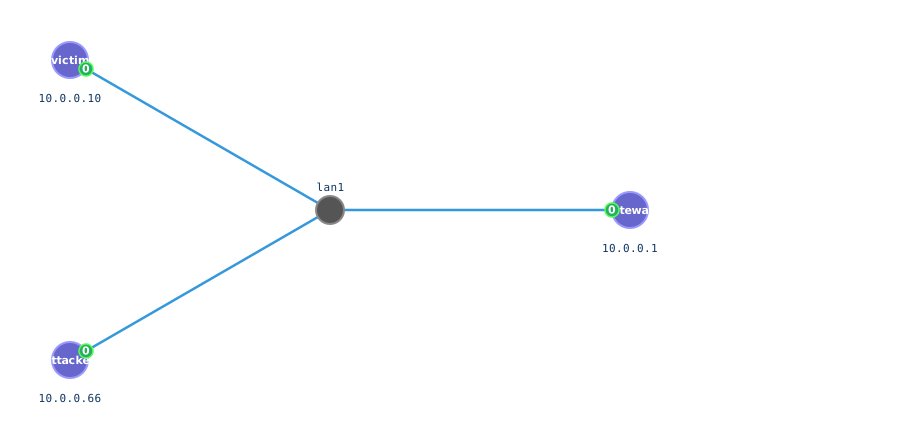
ARP was written by David Plummer in 1982, RFC 826, one page: a machine that needs the mac behind an IP shouts the question on the wire, the owner answers. It has no notion of who may answer, and a host takes the newest reply, so a machine on the lan can claim any address by saying so. The attack was folklore for years; Dug Song made it a command in 1999 with dsniff, whose arpspoof is used here. The defence, dynamic ARP inspection on the switch, checking arp against the DHCP leases, came much later and lives in the switch, not in the protocol.
Today: arp is unchanged and still trusted on every IPv4 lan; the poisoning is a standard step of a man-in-the-middle on a local network, and the reason a network pins its gateway and inspects arp at the switch. IPv6 replaces arp with neighbour discovery, protected by SEND, rarely deployed.
Three containers, one lan, image arp_trixie (dsniff for arpspoof, arping):
cloonix cli nemo demo security/arp.py
A victim, its gateway, and an attacker on one lan. The victim resolves the gateway honestly; the attacker runs arpspoof and the victim's entry for the gateway moves to the attacker's mac, a machine in the middle; a static entry pins the gateway back and the same forgery no longer moves it. arp has its own ethertype:
cloonix cli nemo sniff victim eth0 --dump arp
cloonix cli nemo ssh victim "ip neigh show dev eth0"
cloonix cli nemo ssh attacker "arpspoof -i eth0 -t 10.0.0.10 10.0.0.1"
User documentation ‹ 18. Routing › 20. Services and availability