User documentation ‹ 13. The web canvas › 15. Cloonix items managed
14. The demos of cloonix
Each demo of demos/cloonix/ shows one piece of cloonix at work: an item, a capture, a cable to another net. They are the reference of what cloonix does; the demos of the other areas, in the part The demos: networking culture, use cloonix to show the protocols of the internet.
14.1. Layout
One level under demos/, in the source tree, in /usr/share/cloonix/demos and in the toy: an area, then one python file per demo:
demos/routing/frrmix.py
       ^       ^
       |       the demo
       the subject area
Three sit at the top, windows.py, freebsd.py and cisco.py: there the guest is the subject. The areas:
cloonix       a2b c2c cnt cntkvmwifi cntwifi kvm kvmwifi limit mount nat nginx phy realnet snf systemd
switching     ovn stp vlan vxlan
routing       babel batman bird frrmix frrspider frrspider_bgp isis
address       dhcp dns ipv6 knot ntp unbound
security      arp ebpf ipsec nftables openvpn radius suricata tinc tls wg
services      asterisk mqtt proxy smtp squid
availability  cluster vrrp
watching      perf
wifi          cnt_bridge cnt_mesh cnt_open cnt_roaming cnt_wpa2 cnt_wpa3
              kvm_bridge kvm_mesh kvm_open kvm_roaming kvm_wpa2 kvm_wpa3
              cntkvm_enterprise cntkvm_home cntkvm_monitor cntkvm_roaming
The Demo picker of the canvas does not show the areas: it shows the packages of the chapter Learning with cloonix, read from demos/packages.
What a demo is about is the docstring at its top: the network as ascii art, the acts, the image, the packet to catch. cloonix cli <net> demo lists each demo with the first line of that docstring, and the canvas shows the whole of it in the About view of its History popup.
14.2. One form
A demo is a python programme, shebang, standard library, the net name as its only argument, nemo by default:
./routing/frrmix.py nemo
cloonix cli nemo demo routing/frrmix.py
cloonix cli nemo demo frrmix
Outside the cloonix area, a demo opens its history with HISTORY, a paragraph on where the protocol comes from and who wrote the software it runs; the same paragraph heads its section in the part The demos: networking culture.
The functions every demo shares, run, ssh, the waits, erase_net, place, story, are in demos/lib/demolib.py, and what the wifi demos share in demos/lib/wifilib.py: lib is the one directory of demos that is not an area, absent from every demo list; a demo imports from it the names it uses.
In the source every command is written whole, cloonix cli included, and every command prints itself as it runs, so a run is a worked example:
$ cloonix cli nemo add cnt a10 eth=1 trixie
$ cloonix cli nemo plug a10 eth0 lan_trunk
$ cloonix cli nemo ssh a10 "ip link add link eth0 name eth0.10 type vlan id 10"
A demo checks that the net is up and that its image is in bulk before building anything, printing the refusal of the server, which names the build script and the download, when it is not. It then erases the net, del all, and reads the topology until it is empty, so every run starts on a clean canvas, and sends the position of each item and the angle of each interface before creating them, so the topology is drawn as its figure in this chapter and nothing lands on the layout spiral. A result is shown at reading speed: a ping is five pings with its last lines in the history, and what an act proved stays there four seconds, blank lines around it, before the next act starts; CLOONIX_DEMO_FAST=1 removes the pauses for a script, debug/demo_test.py sets it, and a terminal run has none. A demo that has something to try by hand while it runs, a published port to open in a browser, stops and asks for Enter, in the terminal or in the Demo panel of the canvas; run by a script, with nobody to answer, it goes on. Every demo ends with the network running.
The image of a demo is ROOTFS_CHOICES at the top of the script; the builders are in vm_create/cnt_kvm_demo, keyed by the demo name, frr for the three frr demos:
cd vm_create/cnt_kvm_demo
./doitall.sh frr                the images the frr demos need
./doitall.sh --all              every image every demo needs
Two tools in debug/:
debug/check_demos.py            static: depth, docstring, erase and place, scripts compile
debug/demo_test.py nemo         runs every demo under a timeout and reports
debug/demo_test.py nemo --only vlan,stp
14.3. Two readers
A demo writes for two readers and keeps them apart.
The console, a terminal or the log of the Demo panel, receives the cloonix commands and nothing else, so that it reads as the list of what to type to build the same thing by hand:
$ cloonix cli nemo add cnt gwA eth=2 wg_trixie
$ cloonix cli nemo plug gwA eth1 lanC
$ cloonix cli nemo ssh gwA "ip link add wg0 type wireguard"
The history is everything else: the paragraph on the protocol, what each step is for, the output of the ping or the capture that proves it, the commands it suggests once it is over. It is shown by the History popup that the Demo panel opens on the canvas, step by step, each step folding the commands it ran; the chapter on the web canvas describes it. A terminal run does not print it, and does not pause for it either:
./security/wg.py                          the commands
CLOONIX_DEMO_STORY=1 ./security/wg.py     the commands and the history,
                                          each history line marked #story#
A refusal, the image is not in bulk, or a failure, the string was still readable on lanC, is for both readers: it is printed on the error output, shows in the terminal and in the log, and the popup repeats it in red.
14.4. cloonix/cnt.py and cloonix/kvm.py
The two networks of the chapter First run, played by a program: two containers on one lan and a ping, then the same with two virtual machines, image trixie and trixie.qcow2:
cloonix cli nemo demo cloonix/cnt.py
cloonix cli nemo demo cloonix/kvm.py
Each prints every command as it runs it, the same lines as the chapter, so the output is the chapter with the addresses filled in and the ping answered. The chapter The first network says the same for the canvas.
14.5. cloonix/a2b.py

Two containers, one a2b, image wg_trixie or proxy_trixie, whichever is in bulk:
cloonix cli nemo demo cloonix/a2b.py
Both wires are sniffed. Delay is timed per direction, the echo request on hostA's wire and on hostB's; loss names the sequence numbers that never arrived; rate sends udp at 130 kB/s through a 100 kB/s cap and counts the datagrams on each wire:
cloonix cli nemo cnf cable A2B delay=100
cloonix cli nemo cnf cable A2B loss=100
cloonix cli nemo cnf cable A2B rate=100
cloonix cli nemo cnf cable A2B silentms=200
cloonix cli nemo sniff hostB eth0 --dump icmp
14.6. cloonix/snf.py

Four containers on one lan, image wg_trixie, proxy_trixie, smtp_trixie or mqtt_trixie, the first one found in bulk. noisy1 broadcasts five hundred datagrams a second on ports 10000-10100; alice sends bob one beacon a second on port 53 and one ping. Four subscriptions to the same interface, four filters:
cloonix cli nemo demo cloonix/snf.py
filter                              packets  of the whole
(none)                                 2012        100.0%
not udp portrange 10000-10100            12          0.6%
udp port 53                               4          0.2%
icmp                                      8          0.4%
The icmp count includes the port unreachable that bob's kernel answers to each beacon.
14.7. cloonix/nat.py

Three containers, two lans, one nat, image nft_trixie:
cloonix cli nemo demo cloonix/nat.py
passt answers the dhcp of gw with 10.117.0.10, inside1 reaches the outside by routing through gw, and the loopback of the host is reached from inside at 10.117.0.1:
cloonix cli nemo sniff gw eth1 --dump "udp port 67 or udp port 68"
14.8. cloonix/c2c.py
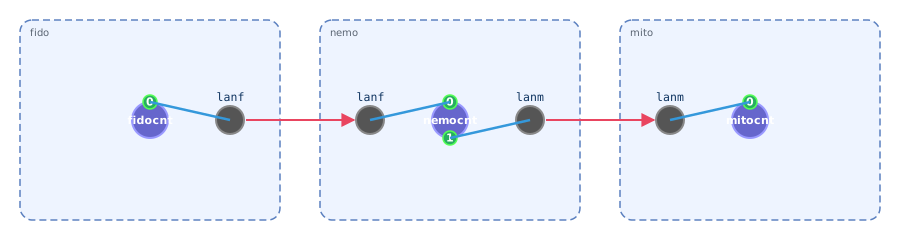
Three servers, two c2c, one container each, image trixie:
cloonix start nemo ; cloonix start fido ; cloonix start mito
cloonix cli nemo demo cloonix/c2c.py nemo fido mito
Both c2c are created from the centre, nemocnt routes between the two subnets, and the last act pings from fidocnt to mitocnt:
64 bytes from 10.20.0.2: icmp_seq=1 ttl=63 time=0.5 ms
ttl=63: one router on the path, and two c2c crossed without a decrement. Needs three net blocks in cloonix.cfg, each with its own c2c_udp_port_low.
14.9. cloonix/nginx.py
One container, one lan, one nat with a published port, image proxy_trixie:
cloonix cli nemo demo cloonix/nginx.py
cloonix cli nemo add nat nat1 publish=8080:80
curl http://127.0.0.1:8080/
The page answers hello from cloonix container Cnt1 from a container with no address on any network of the host.
14.10. cloonix/mount.py
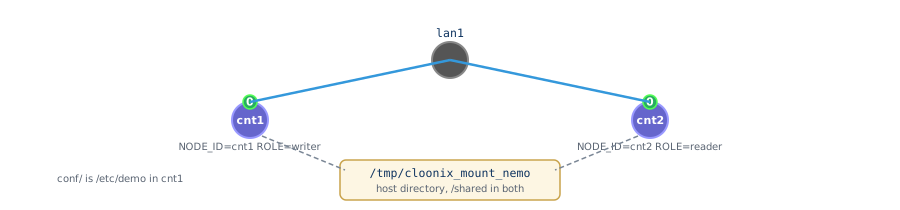
Two containers, image trixie, both given a host directory and a variable:
cloonix cli nemo demo cloonix/mount.py
cloonix cli nemo add cnt cnt1 eth=1 trixie startup_env="NODE_ID=cnt1 ROLE=writer" \
        vmount="/tmp/cloonix_mount_nemo:/shared /tmp/cloonix_mount_nemo/conf:/etc/demo"
The variables are read from /proc/1/environ of each; cnt1 writes in /shared, cnt2 and the host read it; the host writes conf/demo.conf and cnt1 reads it at /etc/demo; then cnt1 is deleted and made again: the file in the mount is still there, the one written in /root is gone. The demo makes the directory on the machine of the server, where a mount takes its source.
14.11. cloonix/limit.py
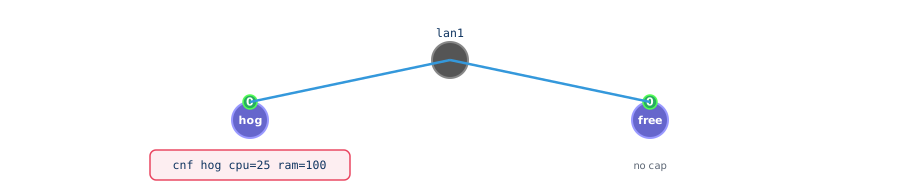
Two containers, image trixie, one capped:
cloonix cli nemo demo cloonix/limit.py
cloonix cli nemo cnf hog cpu=25 ram=100
cpu.max and memory.max are read inside hog; a busy loop in each container is measured over five seconds with cpu.stat; 300 M are allocated in each and hog is killed at 100; then the cap is lifted with cpu=0 ram=0 and dump pid prints the cost of every guest.
14.12. cloonix/systemd.py

Three containers, one with an init, image trixie_systemd:
cd vm_create/cnt_kvm && ./cnt_trixie_systemd.sh
cloonix cli nemo demo cloonix/systemd.py
The three ping each other; the demo reads pid 1, systemctl and the process count of each, then prints fs.inotify.max_user_instances and how many instances the host has open.
14.13. cloonix/cntwifi.py
Two containers with a radio each, wlan=1, on the air cntwifi, the amber lan of the canvas. The radios join one ad hoc network, no access point and no key, and ping each other:
sudo modprobe mac80211_hwsim radios=0
cloonix cli nemo demo cloonix/cntwifi.py
cloonix cli nemo cnf cntwifi sniff=on
cloonix cli nemo sniff cntwifi
Package 10, wifi/, has the access points, WPA2, WPA3, a bridge, roaming and a mesh. The chapter Wifi: from the radio to the ip stack has the frames these demos show, beacon to encrypted data.
14.14. cloonix/kvmwifi.py
Two kvm with a radio each, wlan=1, image trixie.qcow2: the cloonix/cntwifi.py of the kvm. The cloonix agent of each guest loads mac80211_hwsim in the guest kernel, makes the radio wlan0 and registers as the medium of the guest; the frames travel on the agent channel to doorways, relayed to suid-power, which gives them to the radios on the same air and writes them to its capture. The radios start on the air kvmwifi. k1 makes the ad hoc cell, k2 joins it, k1 pings k2, and the ping is counted on the air:
cloonix cli nemo demo cloonix/kvmwifi.py
cloonix cli nemo cnf kvmwifi sniff=on
cloonix cli nemo sniff kvmwifi
Package 10, wifi/, plays each of its demos with kvm too, wifi/kvm_.
Double-click the air kvmwifi for its webshark, decoded as the air cntwifi.
14.15. cloonix/cntkvmwifi.py
A container and a kvm with a radio each, wlan=1, images trixie and trixie.qcow2. The container radio is made by suid-power in the kernel of the host, the kvm radio by the cloonix agent in the kernel of the guest; suid-power is the medium of every air, so both meet on one air. The kvm radio starts on kvmwifi and is put on cntwifi, the air of the container. c1 makes the ad hoc cell, k1 joins it, they ping each other both ways, and the ping is counted on the air:
sudo modprobe mac80211_hwsim radios=0
cloonix cli nemo demo cloonix/cntkvmwifi.py
cloonix cli nemo plug k1 wlan0 cntwifi
cloonix cli nemo cnf cntwifi sniff=on
cloonix cli nemo sniff cntwifi
14.16. cloonix/phy.py
A real interface brought into a net, both ways, images python_trixie.qcow2 and trixie, cloonix installed on the host:
cloonix cli nemo demo cloonix/phy.py
Two kvm on one lan, each running a cloonix of its own, fido in mcv and mito in abs, both nets of cloonix_config.py at 127.0.0.1 so the inner server needs no address on eth0. In mcv, 2.2.2.1 stays on eth0 and add phy eth0 --macvlan makes eth0_1, on a lan with the container c1 at 2.2.2.2. In abs, add phy eth0 makes eth0_0 and ifconfig no longer lists eth0; the container c2 at 2.2.2.3 is on a lan with it. c2 pings 2.2.2.1 and 2.2.2.2 across the outer lan, c1 pings c2; mcv itself does not reach c1, which is the kernel's rule for a macvlan in bridge mode: frames go to the wire and to the sibling macvlans, never to the parent's own stack. The icmp of c2 is caught on the outer lan at the eth0 of abs, the interface the kvm no longer has.
14.17. cloonix/realnet.py
The recipe A guest on the real network played inside a kvm, images python_trixie.qcow2 (trixie plus python3, for the client), trixie.qcow2 and trixie, cloonix installed on the host:
cd vm_create/cnt_kvm_demo && ./kvm_python_trixie.sh
cloonix cli nemo demo cloonix/realnet.py
Two kvm on one lan. The installed cloonix of the host, and the container image packed from inside a container running it, since in bulk its files belong to whoever built it, are copied into endu, which makes br0 with eth0 and 192.168.100.175 and starts cloonix start endu inside; on that inner net a container and a tap are cabled, the tap goes into br0, and the container at 192.168.100.153 pings the other kvm at 192.168.100.238. The icmp is caught on the outer lan at the eth0 of station. Every inner command is a cloonix cli nemo ssh endu carrying a cloonix cli endu.
14.18. How to read the timestamps
Each sniffed interface has its own cloonix-ovs-snf process stamping packets in its own read loop. Within one interface the order is reliable; across interfaces a few milliseconds of skew is normal, and a cluster of packets sharing one timestamp on one interface is that sniffer catching up after being descheduled. The demos judge themselves on what a participant received and print the packet counts beside it.
User documentation ‹ 13. The web canvas › 15. Cloonix items managed