User documentation ‹ 14. The demos of cloonix › 16. Recipes
15. Cloonix items managed
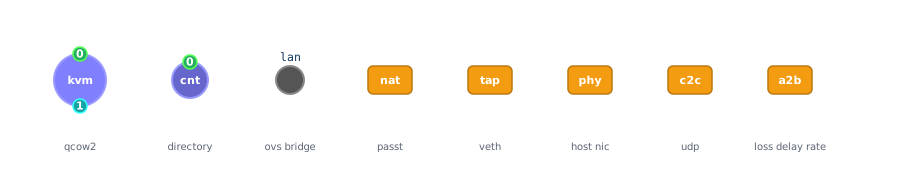
15.1. lan
The switch that connects every other object: an openvswitch bridge named _b_<lan> inside the namespace cloonix_<net>. A frame entering by one port leaves by the port that learnt the destination, or by every other port when it is broadcast or unknown. A lan appears with its first cable and disappears with its last:
cloonix cli nemo plug kvm1 eth0 lan1
cloonix cli nemo unplug kvm1 eth0 lan1
An interface of a kvm or a container is named as in the guest, eth<i> or wlan<i>: an eth goes on a lan, a wlan on an air. An a2b has two sides, A and B. A tap, a nat, a c2c or a phy has one interface, and an air one capture: no interface is named for them:
cloonix cli nemo plug tap1 lan1
cloonix cli nemo cnf cntwifi sniff=on
cloonix cli nemo sniff cntwifi
The same names serve cnf, sniff and unplug, and dump commands writes them.
15.2. kvm
A qemu virtual machine. The qcow2 of bulk is the backing file of a fresh overlay in /var/lib/cloonix/<net>/vm/, so a machine starts clean every time unless --persistent writes into the bulk file:
cloonix cli nemo add kvm vm1 ram=2000 cpu=2 eth=2 trixie.qcow2
cloonix cli nemo add kvm vm1 ram=2G cpu=2 eth=2 trixie.qcow2 --persistent
ram= is in megabytes, or with M or G. A windows disk is added with add win, a freebsd disk with add freebsd, a cisco ios-xe disk with add cisco: each sets what that kind of disk needs; the chapter on the client has the options.
15.3. cnt
A crun container: a process tree in a private file-system with its own namespaces, the root file-system being a directory of bulk mounted as the lower layer of an overlay. The image is never modified unless --persistent:
cloonix cli nemo add cnt cnt1 eth=1 trixie
A container runs no init by default. Its pid 1 is cloonixsbininit from the agent disc: it starts the agent, the exec server and the syslog daemon of the image, waits for the interfaces and keeps the container alive. An init is run when asked:
cloonix cli nemo add cnt sysd1 eth=1 trixie_systemd startup_env="CLOONIX_WITH_SYSTEMD=1"
Each systemd costs several inotify instances, counted by the kernel per user with a default of 128 shared by every container and every other program of the session; past about two dozen, a systemd container dies a second after its start with nothing logged. A router has no use for an init, and without one the same host carries hundreds of containers. For many systemd containers:
sudo sysctl -w fs.inotify.max_user_instances=8192
The demo cloonix/systemd.py shows one systemd container beside two plain ones and prints the margin of the host.
The image may be left as the downloaded <image>.tar.gz: when no directory
of that name is in bulk, the first add cnt extracts the archive into
<image>_targz and creates the container on it, as does every later one on
any net of the machine; the topology shows <image>_targz. That tree stays
the content of the tar.gz: it is mounted read only for each container,
--persistent is refused on it, and it is not to be edited on the host. An
image to modify is a copy under another name, cp -a <image>_targz
<other>, which takes --persistent; the chapter on the guest root
file-systems has the rule in full. A directory whose top has no write bit
for its owner is refused --persistent too, whatever its name.
The owner of the image directory does not matter: it is mounted for each container with its owner's ids translated into those of the user who started the net, so an image unpacked with sudo, by another user, or copied from another machine runs as it is. An image that is not in bulk is refused with the builder that makes it named in the refusal.
A container of the toy has no user namespace, the toy's own map leaving no uid to give it; its root is the user. In the bundle every container has one, and a request without is refused.
15.4. tap

A veth pair: the end named tap1 stays in the host namespace, its peer goes into cloonix_<net> and onto the lan:
cloonix cli nemo add tap tap1
cloonix cli nemo plug tap1 lan1
ip link show tap1
On the host side tap1 is an ordinary interface attached to nothing. What is done with it decides what the lan reaches:
an address on it, and the host talks to the guests of lan1, point to point:
sudo ip addr add 10.0.0.1/24 dev tap1a port of a kernel bridge that also holds a real cable, and the guests of lan1 are stations of that cable's segment, with addresses of that segment:
sudo ip link set tap1 master br0
Without one or the other the frames of the guests reach the host's ip stack and go no further. The recipes chapter has both cases written out.
15.5. nat
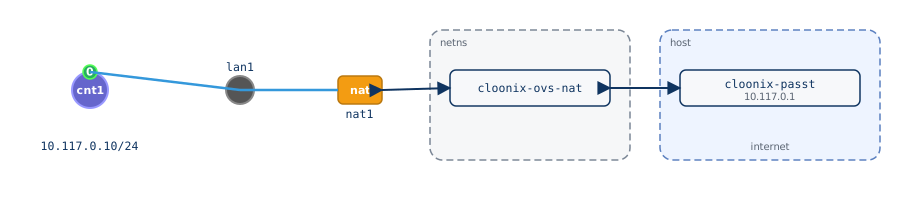
A cloonix network is isolated; the nat is the way out. It is built on passt: the passt process runs on the host, unprivileged, spawned by proxymous, and owns the real v4 and v6 sockets; cloonix-ovs-nat in the namespace shuttles the frames between the ovs port and the passt socket:
cloonix cli nemo add nat nat1
cloonix cli nemo plug nat1 lan1
cloonix cli nemo plug cnt1 eth0 lan1
cloonix cli nemo ssh cnt1 "dhclient eth0"
passt answers the dhcp: the guest gets 10.117.0.10/24, gateway 10.117.0.1, dns forwarded to the resolver of the host; a host with no resolver but a loopback one has nothing to forward to, and the guests are then given 9.9.9.9 by dhcp. Outbound tcp, udp and icmp work, v4 and v6. The gateway address is mapped onto the loopback of the host, so a server on 127.0.0.1 of the host is reached from the guest at 10.117.0.1: this is how a guest installs packages from a local mirror. One nat serves one guest.
Published ports, spelled as docker's -p:
cloonix cli nemo add nat nat1 publish=8080:80
cloonix cli nemo add nat nat1 publish=8080:80/tcp publish=5353:53/udp
cloonix cli nemo cnf nat1 publish=9090:80
cloonix cli nemo cnf nat1 publish=none
Single ports, sixteen at most, tcp when the protocol is left off. A cnf replaces the whole list and restarts passt: every connection through that nat is cut, the guest keeps its address. A port already taken on the host is refused by passt, in the passt log beside the nat socket. The demos cloonix/nat.py and cloonix/nginx.py show both.
15.6. c2c
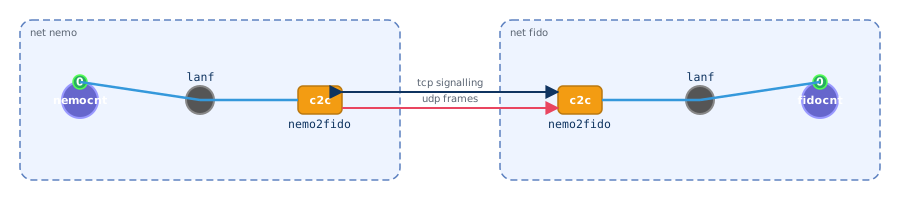
A cable to another cloonix net, on the same machine or another. The master is the one given the name of the distant net; it creates both ends, connects over tcp and negotiates the udp port that carries the frames:
cloonix cli nemo add c2c nemo2fido fido
cloonix cli nemo plug nemo2fido lanf
cloonix cli fido plug nemo2fido lanf
Run the command on one side only; two masters destroy and restart each other for ever. dump commands of the far net writes the add c2c as a comment, so the scripts of both nets replayed make one cable. Light green on the canvas: tcp and udp both peered; light red: tcp only, which means c2c_udp_ip is not an address the far side can send udp to; red: neither. Each c2c takes the first free udp port at or above c2c_udp_port_low, scanning a hundred; a net serves five c2c relays at a time and refuses a sixth naming the five. A firewall between the two machines lets the whole range through. A c2c is a cable: ttl is not decremented across it.
15.7. a2b

Two sides, A and B, and a degradation of what crosses, per direction, A2B or B2A:
cloonix cli nemo add a2b cable
cloonix cli nemo plug hostA eth0 lanA
cloonix cli nemo plug cable A lanA
cloonix cli nemo plug cable B lanB
cloonix cli nemo plug hostB eth0 lanB
cloonix cli nemo cnf cable A2B delay=100      100 ms, side A to side B
cloonix cli nemo cnf cable A2B loss=100       1% dropped
cloonix cli nemo cnf cable A2B rate=100       100 kB/s
cloonix cli nemo cnf cable A2B silentms=200   bursts: 200 ms closed, 200 ms open
A2B is side A to side B, B2A the other way. loss counts in 1/10000, so 100 is 1%; delay is in ms; rate in kB/s; silentms closes the wire for that many ms then opens it for as long, so what arrived during the silence leaves in a burst; 0 removes any of them. The same four sliders are Tune a2b in the right-click menu.
rate sizes the queue and the burst with it. Two keys set them by hand:
cloonix cli nemo cnf cable A2B qsize=64       64 kB held, then dropped
cloonix cli nemo cnf cable A2B bsize=2        2 MB of burst allowed
qsize is the queue kept before a frame is dropped, in kB; bsize is what the bucket lets through at once after an idle time, in MB. A rate= after them sizes both again.
The a2b also rewrites an address as the frame crosses, per direction, ip header and checksums redone:
cloonix cli nemo cnf cable A2B replace_ipsrc 10.0.1.2 with 10.0.9.2
cloonix cli nemo cnf cable A2B replace_ipdst 10.0.2.2 with 10.0.9.9
cloonix cli nemo cnf cable A2B unreplace_ipsrc
cloonix cli nemo cnf cable A2B unreplace_ipdst
replace_ipsrc changes the source of what crosses that way, replace_ipdst the destination; the ipv4 header and the checksums of icmp, udp and tcp are redone. An arp crosses untouched, so the hosts resolve the addresses they are configured with.
15.8. phy
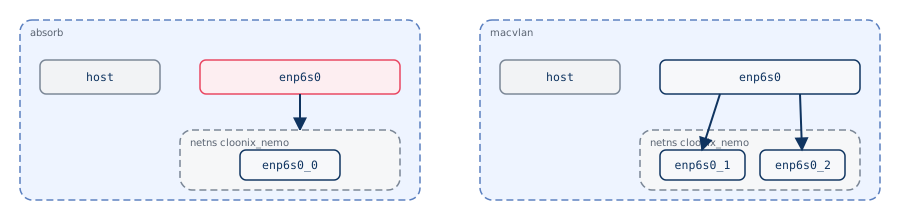
A physical interface of the host brought into cloonix_<net>. absorb takes it away from the host; the item gets the suffix _0:
cloonix cli nemo add phy enp6s0
sudo ip netns exec cloonix_nemo ip link
cloonix cli nemo plug enp6s0_0 lanx
cloonix cli nemo del enp6s0_0                gives it back
macvlan leaves the host its interface and makes an instance with its own mac, suffixed by its rank:
cloonix cli nemo add phy enp6s0 --macvlan enp6s0_1, then enp6s0_2
A tab after add phy lists the physical interfaces of the server, the next one offers --macvlan, absorbed without it. On the canvas the same choice is the phy entry of the menu, one line per interface and kind. A phy is born without capture capability, like a tap; sniff=on, a sniff, or Sniff on adds it. The demo cloonix/phy.py plays both kinds inside two kvm.
A wifi interface in managed mode carries frames under its own mac only, so a wlan absorbed or macvlanned sends the guests' frames into the air and nothing comes back; the server says so when it sees a radio behind the name. Guests reach the web through such a machine with a nat.
15.9. air
The lan of the radios. A container or a kvm gets radios with wlan=N; each is a wlan of the guest, on an air. The radios of the containers start on the air cntwifi, those of the kvm on kvmwifi, and plug puts a radio on any other air, which appears with its first radio:
cloonix cli nemo add cnt sta1 eth=1 wlan=1 trixie
cloonix cli nemo plug sta1 wlan0 air1
cloonix cli nemo cnf air1 sniff=on
cloonix cli nemo sniff air1
A frame sent on an air reaches the radios of that air only; the containers and the kvm share one air when their radios are put on it. An air is captured as a whole: a wlan has no capture of its own. The chapter Wifi: from the radio to the ip stack has the frames.
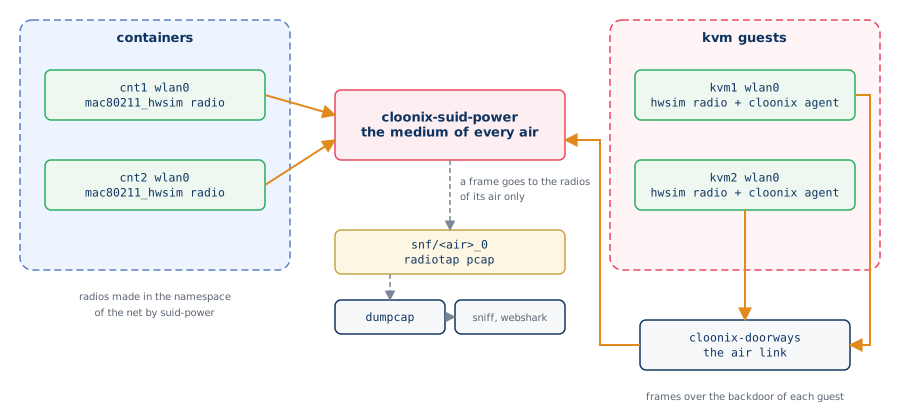
The radios are mac80211_hwsim radios, the simulated card of the Linux kernel written by Jouni Malinen in 2008, the author of hostapd and wpa_supplicant. For the kernel they are real wifi cards: hostapd and wpa_supplicant run on them unchanged. mac80211_hwsim can give every frame to a process instead of delivering it itself, and cloonix-suid-power is that process for every radio of a net: it is the medium of every air.
A container gets its radios with wlan=N. cloonix-suid-power makes them in the namespace of the net and moves each into its container, where it is wlan0, wlan1.
A kvm gets its radios with wlan=N too. The cloonix agent inside the guest loads mac80211_hwsim in the guest kernel, makes the radios, and sends their frames over the backdoor of the guest. cloonix-doorways hands them to cloonix-suid-power on the air link. So a container and a kvm can be on one air: wifi/cntkvm_home.py.
Every frame goes to the radios of its air only. plug puts a radio on another air; a station leaving the air of its access point loses it, as a phone walking out of a room (wifi/cnt_roaming.py).
An air is captured when asked: cnf <air> sniff=on, or a sniff. Its frames are written as a radiotap pcap to snf/<air>_0, served by cloonix-dumpcap to sniff and to webshark.
sudo modprobe mac80211_hwsim radios=0
cloonix cli nemo demo wifi/cnt_wpa2.py
cloonix cli nemo cnf cntwifi sniff=on
cloonix cli nemo sniff cntwifi --line
radios=0 loads the module with no radio of its own: cloonix makes them. On the canvas, a double-click on the air opens its webshark.
15.10. The interfaces
Every interface is born not capturable, and is made capturable when a capture is wanted:
capturable        mirrored to a second ovs port, drawn green
not capturable    no mirror, lighter, drawn cyan
The capability is toggled while the guest runs:
cloonix cli nemo cnf cnt1 eth0 sniff=on
cloonix cli nemo cnf cnt1 eth0 sniff=off
or with Sniff on / Sniff off on the dot. A sniff of an interface not capturable makes it capturable first. The mirror costs a copy of every frame; a net of many routers keeps it for the interfaces being watched.
15.11. Names and limits
A name of an item or of a lan, checked by the server in one place (name_is_sane(), cfg_name_is_in_use()):
letters, digits, _ - .          nothing else
1 to 63 characters              MAX_NAME_LEN is 64, the last byte ends it
no leading - or .               no .. anywhere
bulk, cloonix, lan, all         refused: words of the system and of the client
cntwifi, kvmwifi                refused: the default airs of the radios
eth<i>, wlan<i>, A, B           refused for a lan or an air: words of an interface
one name, one item              a lan and an item cannot share it
The counts the server enforces at creation:
eth of a kvm or a cnt           32 at most (MAX_ETH_VM)
radios of a cnt or a kvm        4 at most (MAX_VWIF), wlan=N; a kvm: linux guest
name of a tap                   15 characters at most, a host interface name
image named, not a path         63 characters at most, the name rule above
airs captured at once           32 (MAX_AIRS)
A refused creation answers the client with the rule it broke:
~$ cloonix cli nemo add cnt a/b eth=1 trixie
... bad name a/b: letters, digits, _ - . only, not starting with - or ., under 64 chars