Developer documentation ‹ 3. Signalling and data flows › 5. cloonix-suid-power, the privilege boundary
4. The event loop and the rpc
Every binary is built on two libraries.

4.1. lib_io_clownix
Set up, register callbacks, call the loop, never return.
A callback runs to completion. No preemption, no locking. A callback that blocks stops the process: a system(), a read on a pipe with nobody writing, a long loop. Slow work is forked, pid_clone.c in the main server. The gui server is the one binary with threads beside its loop; they hand every request for the main server to the loop through a queue, the gui server chapter has it.
An llid is not a file descriptor. It indexes the channel table and is not recycled the moment it closes, so a late callback carrying a dead llid is detected.
KOUT kills the process, KERR does not. KOUT for a state that cannot be true; KERR for something wrong the process survives.
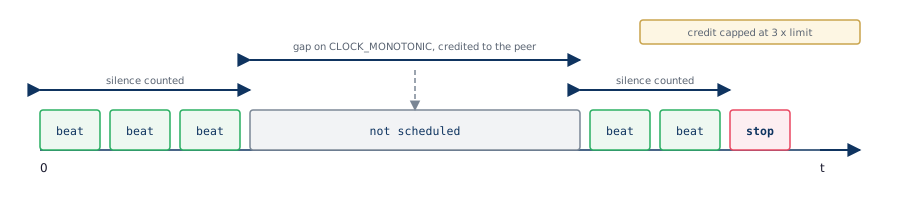
A beat is 10 ms, and a beat is not a clock. The timers count beats of the loop; a process that was not scheduled misses beats without noticing. Anything that judges a peer by its silence measures the silence on CLOCK_MONOTONIC (stall_detect.h) and credits back the stretches during which it was not running itself, up to a cap. The line that reports such a stretch says what the process did in it: cpu near the gap is a loop that turned too slowly, forced switches a starved process, voluntary switches or major faults one blocked in the kernel. The loop itself says, at most once per ten seconds, where a late turn lost its time (late loop: epoll_wait back late, or one turn of callbacks and its cpu). A stall line ends with what the machine did meanwhile, from /proc/stat: steal, softirq, iowait, idle.
KERR never blocks. syslog(3) waits while the log daemon does not read /dev/log; KERR sends on a non-blocking socket of its own, a full socket drops the line, and the first line that passes says how many were lost and for how long. KOUT waits one second for its last word.
msg_mngt_loop()                     never returns
clownix_timeout_add(beats, cb, ...) a one-shot timer, one beat is 10 ms
string_server_unix(path, cb, name)  listen, one line per message
string_client_unix(path, err, rx)   connect to one
proxy_traf_tcp_server(port, cb)     listen on tcp, every address
msg_delete_channel(llid)            close and forget
4.2. lib_rpc_clownix

A message is one line of json with a fctident:
{"fctident":"add_vm","tid":42,"name":"k1","vm_id":3, ... }
json_interface.c holds a send_xxx and its parser for each; nothing is generated. The reader the parsers share -- a key lookup on one flat object, json_get_int, json_get_str, json_escape, the fctident -- is glob_include/json_min.c, one copy for json_interface.c, json_doors.c and rpct.c alike. tid is an echo the answer carries back unchanged. A list is emitted inline, never in a second message.
On the doors port a header goes in front of the line: 14 bytes of magic and fields, a 32 byte hmac-sha256 keyed by cloonix_passwd padded to 32, two bytes of end magic. A wrong digest closes the connection. See doorways_sock.c of lib_io_clownix and frame() of the python client. The hmac authenticates; the tls proxymous ends on the port encrypts.
rpc_clownix.h carries the enum of every kind of peer, used to route a hop message without a table of sockets per feature:
type_hop_ovs, type_hop_ovsdb, type_hop_endp, type_hop_doors,
type_hop_suid_power, type_hop_gui_server, type_hop_nat_main,
type_hop_proxymous, type_hop_c2c, type_hop_a2b, type_hop_snf
4.3. The wire version
glob_include/glob_wire.h:
CLOONIX_WIRE_VERSION       what this build speaks, sent in the leg request
CLOONIX_WIRE_VERSION_MIN   76, where the numbering was fixed
Bump CLOONIX_WIRE_VERSION when values are added; never move or remove a value; move MIN only when the promise is broken on purpose, and say so in the release notes. The python client carries the same number and the same enums, checked by debug/check_wire.sh. The check at run time is a log line, not a refusal.
Developer documentation ‹ 3. Signalling and data flows › 5. cloonix-suid-power, the privilege boundary