Developer documentation ‹ 4. The event loop and the rpc › 6. The core binaries
5. cloonix-suid-power, the privilege boundary
One binary of the delivery is setuid root, and every operation the kernel refuses to an ordinary user happens here. Source: cloonsrc/suid_power, a Makefile. One process per net, started by the main server, dying with it.
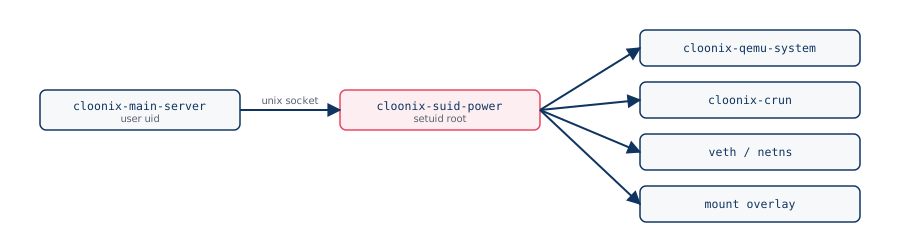
One long-lived process reachable through one unix socket in the work directory of the net, rather than a setuid helper per operation callable by anyone with any argument. Its whole interface is the vocabulary below.
5.1. The vocabulary
Requests, one text line each on the rpc:
cloonsuid_req_launch      name=%s vm_id=%d dtach=%s argc=%d: ...   start a qemu
cloonsuid_req_vm_kill
cloonsuid_req_pid_kill
cloonsuid_req_phy
cloonsuid_req_ovs         tool=ovs-vsctl args: a read of the ovs database, run as root
cloonsuid_req_ns_pid      name=%s pid=%d: one process of the net, for the namespaces
cloonsuid_req_ns_go       read /proc/<pid>/ns of the pids received, answer as ovs lines
cloonsuid_req_spawn       start an ovs satellite: drv, snf, a2b, c2c, nat
cloonsuid_req_suidroot
cloonsuid_air_cnt         name=%s idx=%d air=%s: a cnt radio onto an air, "-" none
cloonsuid_air_kvm         name=%s idx=%d mac=%s air=%s: a kvm radio, made the first time
cloonsuid_air_kvm_del     name=%s: the radios of a kvm that died
cloonsuid_air_snf         air=%s on=%d: the capture of an air, snf/<air>_0
cloonsuid_crun_update     name=%s cpu=%d ram=%d: the caps of a running container
Answers:
cloonsuid_resp_launch_vm_ok   cloonsuid_resp_launch_vm_ko
cloonsuid_resp_pid_ok         cloonsuid_resp_pid_ko
cloonsuid_resp_phy
cloonsuid_resp_ovs_line       cloonsuid_resp_ovs_end     the lines of an ovs read or of dump namespaces
cloonsuid_resp_suidroot_ok    cloonsuid_resp_suidroot_ko
cloonsuid_air_cnt_resp_ok     cloonsuid_air_cnt_resp_ko
cloonsuid_air_kvm_resp_ok     cloonsuid_air_kvm_resp_ko
cloonsuid_crun_update_resp_ok cloonsuid_crun_update_resp_ko
cloonsuid_crun_killed         a container whose crun died, unasked
cloonsuid_trace               a line for trace crun or trace nspace
Containers are driven by a second set on the same socket, one line per step, cloonsuid_crun_<step>, handled in crun.c: create_tar_img (a tar.gz extracted into <n>_targz), create_net, create_eth, create_config_json, create_overlay, create_crun_start, delete. The main server waits for each answer, so a failure stops at its step.
5.2. Making a container

Six steps, in crun.c and crun_utils.c:
crun_utils_create_overlay: overlayfs, the image of bulk read-only below, a writable layer above. Twenty containers share one image.
create_config_json: the OCI spec from the template in config_json.h, mounts, capabilities, uid and gid maps, namespaces.
crun create: the container exists, paused; read_crun_create_pid reads the pid, the handle on every namespace.
crun_utils_create_veth: one end in the switch namespace, the other moved into the container by that pid, before anything runs inside.
crun start.
Teardown in reverse, in three finalizations because a mount can be busy for a moment after its last process dies; a retry is preferred to a failure.
5.3. The console socket
Entering a container's namespaces needs root. The gui server asks on CONSOLE_SOCK in the work directory, one line, console_crun name=<guest>; what is forked is a dtach session running crun exec -ti <guest> /bin/sh, and the reply names the socket to attach to. The socket is chowned to the caller, 0600; the attach is an ordinary dtach -a as the user. A second request for the same container gets the existing socket. cloonix-xwy-srv and cloonix-xwycli, which once did this job, are gone.
5.4. The uid map
Container uid 0 maps to the user running cloonix -- the caller uid of cloonix-suid-power, not the owner of the image -- and container 1 upward to that user's subuid window, added to /etc/subuid and /etc/subgid by tar_img.c when it is missing. The image is not chowned: idmap.c mounts it on <cnt>/lower through a user namespace that maps its owner to the caller and the owner's window to the caller's (open_tree, mount_setattr with MOUNT_ATTR_IDMAP, move_mount; kernel 5.19 or later for the overlay on it). Non persistent, the overlay's lower is that mount, made read only in the same call (idmap_mount_ro, MOUNT_ATTR_RDONLY): the modes of an image are the guest's and cannot protect it, the mount does, which is what keeps a _targz tree equal to its tar.gz; persistent, that mount is the rootfs (idmap_mount) and writes reach bulk translated back. A file whose owner or group is outside the map shows as nobody:nogroup, and container root can neither write, chown nor list it whatever CapEff says; setgroups is denied for the life of the namespace; chown to an unmapped id answers EINVAL.
A privileged container is the unprivileged list minus {"type": "user"}, NAMESPACES_PRIVILEGED in config_json.h. Container root is then host root, with CAP_SYS_MODULE and CAP_MKNOD meaning what they say; crun runs with --cgroup-manager=disabled, so there is no cgroup and no limit. The namespace report of trace nspace has no user line for one. No client flag asks for it any more: it exists for the toy alone, where the promotion below makes every container one, and crun.c refuses the bit outside the toy. The is_privileged field stays on the wire, at 0.
5.5. The owner of an image
get_path_uid_image in tar_img.c takes the uid of the caller, never the owner of the image: idmap.c reads the owner off the tree (tree_owner) and builds the user namespace that maps that owner to the caller, so an image unpacked with sudo, by another user, or copied from another machine runs as it is and is never chowned. uid 0 as caller means the toy, where the crun of the toy maps one uid:
"uidMappings": [ { "containerID": 0, "hostID": __USER_UID__, "size": 1 } ]
and the promotion to privileged in crun.c is that path.
A missing image is refused in the switch, image_missing in recv_from_client.c, before cloonsuid_crun_create_net is sent: the client gets the reason at once and suid-power is not asked. The refusal names the builder of vm_create by the naming rule of the tree.
5.6. The guards
Everything that reaches this process comes from the net owner, an account that is not root, and guard.c is where each root action is bounded to what that account could do alone. One function per shape of argument:
guard |
what it decides |
|---|---|
guard_group_allows |
at start: the caller is root or a member of that group, read from /etc/group with getgrouplist, not from the process credentials, so a usermod is effective without a new login; no group, no gate |
guard_path_in_root |
absolute, no .., under /var/lib/cloonix/<net>: the dtach socket, the launch script, the stderr log |
guard_caller_can_access |
setfsuid to the caller, access(), back to root: can the caller open this file; an absent file is judged by its directory |
guard_launch_line |
the five words of a launch: pinned dtach, -n, socket in root, pinned bash, script in root |
guard_launch_script |
the script: owned by the caller, two lines, the shebang of the cloonfs bash, then exec nsenter --net=<ns> cloonix-qemu-system -L <dir> ..., no shell character, one trailing 2><log> in root, every path of every key=value item openable by the caller |
guard_qemu_token |
one token of the qemu line: the value after the last = of a key=value item, or the whole token; a token holding a slash is a path and the caller must be able to open it |
guard_pid_is_callers |
the pid's real uid is the caller, or its command line names the net directory |
Outside guard.c: ovs_word_allowed refuses any option token, since --log-file or --db would make the tool write or read as root wherever told; spawn_bin_allowed pins the five satellites against pthexec_usr_libexec_cloonix(), and main refuses an argv[3] that differs from it and an argv[2] that is not /var/lib/cloonix/<net>; erase_workdir removes a directory the caller owns; crun.c refuses a privileged container outside the toy, whoever asks.
qemu itself gets -run-with user=<uid>:<gid> from qemu_automaton.c, so it is root only while opening its devices. The four satellites call cloonix_drop_root() from glob_include/name_sane.c right after their tap is open: setgroups, setresgid, setresuid to the caller; their suidroot answer is a handshake and takes nothing.
The directory the scripts live in, /var/lib/cloonix/<net>, is 0700 of the owner, so what root runs cannot be swapped by another local user between the write and the exec.
5.7. Names that become paths
name_is_sane() and path_is_sane() in glob_include/name_sane.c, compiled into every binary: a name is letters, digits, underscore, dash, dot, no leading dash or dot, no ..; a path is absolute with no ... Every argument that becomes a path is checked before it does, in suid-power and in the five ovs satellites alike. erase_workdir, a verb of this binary that removes /var/lib/cloonix/<net>, checks its argument the same way.
5.8. In the rootless installation
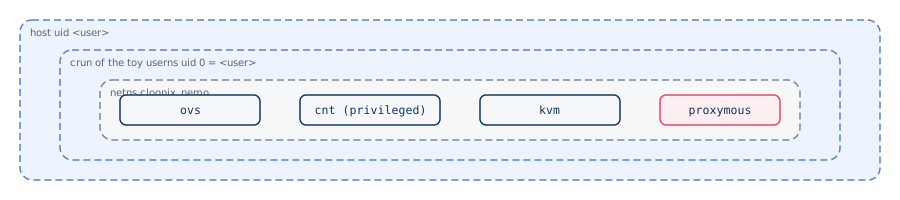
The binary is not setuid there: it is root inside the crun that wraps cloonix, and root inside that namespace is your uid on the disk. Same code, same verbs.
Developer documentation ‹ 4. The event loop and the rpc › 6. The core binaries