Developer documentation ‹ 2. The logic behind the verbs › 4. The event loop and the rpc
3. Signalling and data flows
Two planes run through a net. The control plane carries requests and answers: text rpc, one json line per message, every hop a socket. The data plane carries frames: it lives in the namespace cloonix_<net>, and no frame of a guest crosses the main server.
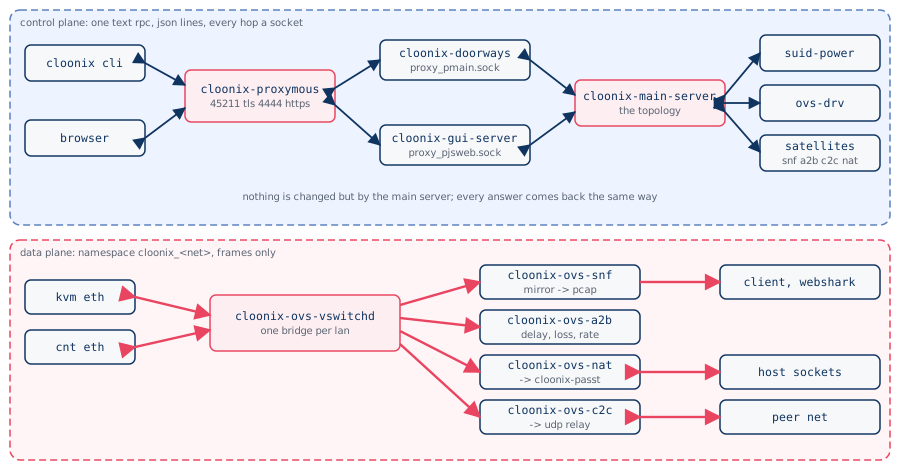
Three rules hold on every path of this chapter:
One writer of the topology. cloonix-main-server alone changes it. A browser, a client, a demo reach it by the same rpc.
An answer states a result. A command is answered ok when the state it asked for is true, never when the request is accepted; where the result takes time, ack_pending.c tests it on a timer, and answers ok, ko or TIMEOUT with the reason.
A silence is measured. A peer judged by its silence is timed on CLOCK_MONOTONIC with the credit of stall_detect.h, never by counting beats of the loop.
3.1. The sockets
Every socket of a net, by who listens on it:
tcp  cloonix_port (45211)            proxymous      doors frames, tls or plain, hmac
tcp  4444                            proxymous      https of the canvas
unix proxy_pmain.sock                doorways       what arrived on cloonix_port
unix proxy_pjsweb.sock               gui-server     what arrived on 4444, decrypted
unix proxymous_demo.sock             proxymous      a demo to run, from the gui server
unix dgram_c2c_<port>_tx.sock        c2c, proxymous one pair per c2c, datagrams
     dgram_c2c_<port>_rx.sock
unix snf/<n>_<num>_pcap_sock         cloonix-dumpcap one per sniffed eth
unix ovsdb_server.sock               ovsdb-server   read by cloonix-ovs-vsctl
unix /cloonixmnt/tmp/unix_cloonix_cxp_sock
                                     cxp-srv        inside a guest, the agent's peer
The paths not absolute are under /var/lib/cloonix/<net> or under the proxyshare directory of the net. cloonix cli <net> dump pid lists every process behind them.
3.2. A command from the client
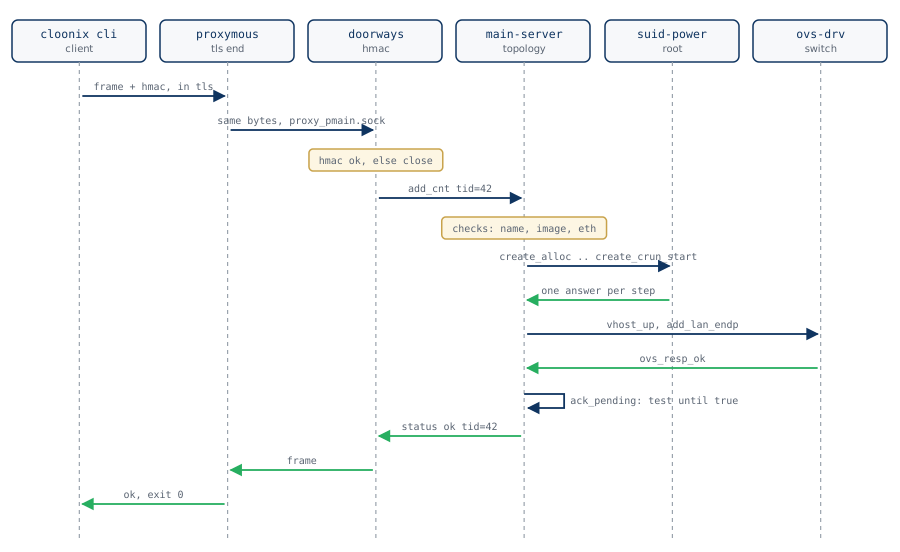
cloonix cli nemo add cnt c1 eth=1 trixie
The client writes a doors frame: a 48 byte header, the json line, an hmac-sha256 keyed by cloonix_passwd. On ip:port the frame travels in tls, which proxymous ends.
proxymous relays the bytes unread to proxy_pmain.sock. doorways checks the hmac; a mismatch closes the connection without an answer.
The main server checks the request: the name is free, the image is in bulk, the eth list is valid. A refusal is answered at once, ko with its reason.
suid-power makes the container, one request per step, each answered: create_alloc, create_net_eth, create_config_json, create_overlay, create_crun_start. A failed step stops the chain at that step.
ovs-drv puts each eth in the switch: the port brought up in the namespace, then plugged into the bridge of its lan.
ack_pending.c tests the result on a timer. The client gets ok when the container runs with every eth in place, with the tid it sent.
The exit code of the client says which side ended the command (EXIT_OK, EXIT_REFUSED, EXIT_LOCAL, EXIT_BUG of cloonix/cloonix):
0   the server said ok
1   the server said no, its reason printed
2   refused on this side: the line, the config, the connection
3   the client itself failed
The same path serves ssh, scp and files, in a leg of type doors_type_dbssh: see The ways in.
3.3. A lan
cloonix cli nemo plug c1 eth0 lan1
A lan is an openvswitch bridge in the namespace, made by ovs-drv on the first eth plugged into it and removed with the last one:
main-server                       ovs-drv                      ovsdb, vswitchd
add_lan lan1        ----------->  ovs_cmd_add_lan      ---->   add-br
add_lan_endp        ----------->  ovs_cmd_add_lan_endp ---->   add-port
                    <-----------  ovs_resp_ok
status ok to the client, topology event to the gui server
cloonix-ovs-drv is one process per net: it creates the namespace, starts cloonix-ovsdb-server and cloonix-ovs-vswitchd inside it, and runs every change of the switch that follows. It reads nothing but the requests of the main server.
3.4. The canvas
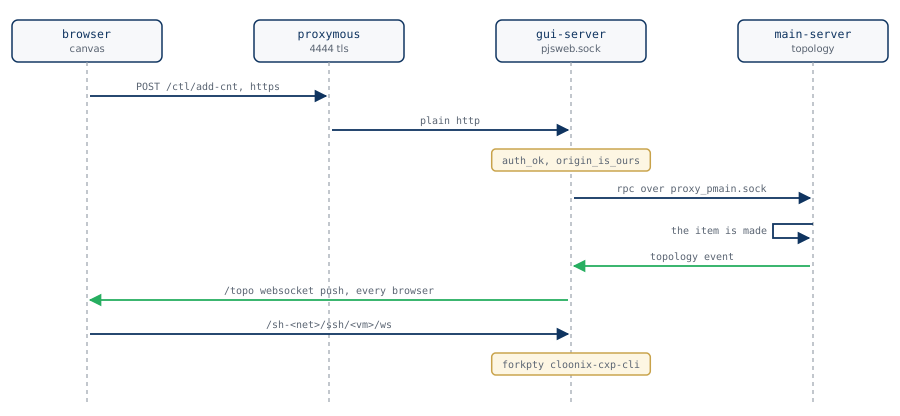
The browser speaks https to proxymous on 4444. The gui server receives plain http on proxy_pjsweb.sock, checks the basic credentials (the net name and cloonix_passwd) and the Origin against the Host, then turns a /ctl/<verb> into the rpc a client would send. The answer to the browser is the topology event: the main server tells its subscribers, the gui server pushes it on every /topo websocket. Two browsers on one net see the same canvas.
A shell of the canvas is /sh-<net>/ssh/<vm>/ws: the gui server runs cloonix-cxp-cli under forkpty and relays the pty on the websocket.
3.5. Into a guest
cloonix cli nemo ssh c1 "ip addr"
client ==doors, dbssh leg==> proxymous -> doorways -> agent socket of c1
  kvm: a qemu chardev, /dev/virtio-ports/net.cloon.0 in the guest
  cnt: a unix socket bind-mounted into the container
cloonix-agent -> /cloonixmnt/tmp/unix_cloonix_cxp_sock -> cloonix-cxp-srv
  EXEC PTY PUT GET PUTTREE GETTREE LIST, one operation per connection
No network interface of the guest is used: the path works on a guest with no eth at all, and a guest whose network is broken stays reachable.
Every queue of the path has a bound, and a byte pipe is paced by header_val_xoff and header_val_xon on its own number, either way:
doorways -> agent       xoff while the client of the pipe is past
                        msg_tx_queue_high() (8 MB), xon under 1 MB
agent -> doorways       xoff while more than 1 MB waits for the exec
                        server, xon under 256 kB; past 32 MB the pipe is
                        closed with a WARNING
doorways                the client of a pipe is not read after an xoff of
                        the agent, nor while the backdoor of the guest is
                        past the mark
agent                   no pipe is read while more than 8 MB waits for the
                        virtio port; no queue passes 64 MB
agent                   30 pipes at most: the next is refused, a WARNING
A pipe held 10 s with its queues not shrinking is a WARNING in doorways, a virtio port that took nothing for 10 s one in the agent.
A KERR of an agent is written in the guest, then sent on the port as header_type_kerr; the linux exec server gives its own to the agent on the datagram socket UNIX_KERR_SOCK (cxp_wire.h). Doorways passes at most ten lines per ten seconds per guest, control bytes replaced, as the event agent_kerr, and the main server writes each in the syslog of the net:
KERR: nemo guest k1: action.c line:280 WARNING byte pipe 41 refused: ...
A line the port cannot take is counted and the next line says how many were lost. The windows agent sends its faults the same way; the windows exec server keeps its own in its log.
3.6. A capture
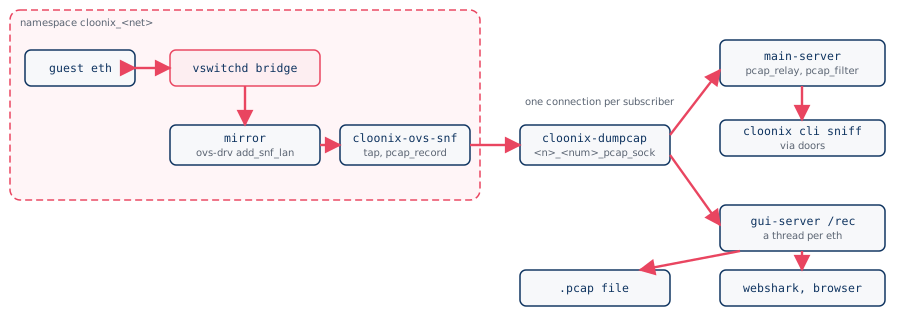
cloonix cli nemo cnf c1 eth0 sniff=on
cloonix cli nemo sniff c1 eth0 --dump icmp
cnf <name> eth<i> sniff=on asks ovs-drv for a mirror of the port (add_snf_lan) and starts one cloonix-ovs-snf on it; cloonix-dumpcap beside it serves snf/<n>_<num>_pcap_sock, one connection per subscriber:
the client: pcap_relay.c of the main server reads the stream, parses each record header, applies the filter of pcap_filter.c (a tcpdump-like grammar, no libpcap) and sends pcap_traffic messages on the doors connection. Past msg_tx_queue_high() (8 MB, msg_layer.c) waiting towards one client, its packets are dropped and counted, so a client that does not read slows nothing but itself.
the canvas: the /rec websocket of the gui server starts a thread per eth that copies the stream into a .pcap file; webshark reads it in the browser.
The capture is a copy of the port: a frame not read by anyone costs the bridge the mirror only.
An snf that goes on its own comes back by itself while its eth is still capturable:
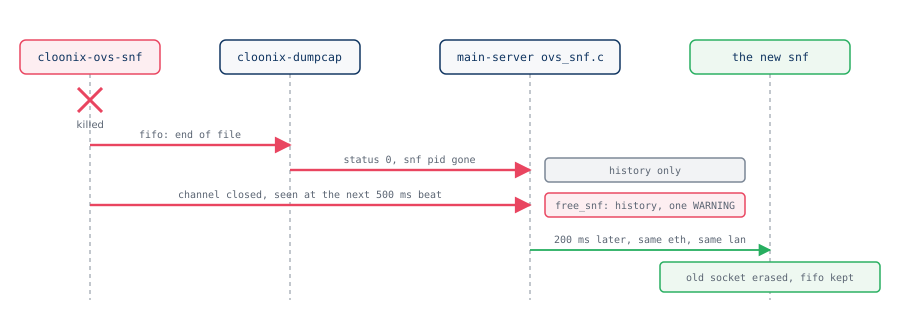
The dumpcap reads the end of its fifo and ends with status 0; its snf pid being gone, that is written in the history and nothing more. The heartbeat of ovs_snf.c (500 ms) sees the channel closed: free_snf() writes the history of the capture once, one WARNING, and timer_snf_defer() starts a new snf 200 ms later on the same eth, mirrored again on the same lan. The new one finds the socket of the old one, erased, and its fifo, kept for a reader that may be waiting on it (ctrl_link.c). A dumpcap that dies with its snf alive is started again 300 ms later, five times at most.
3.7. The nat
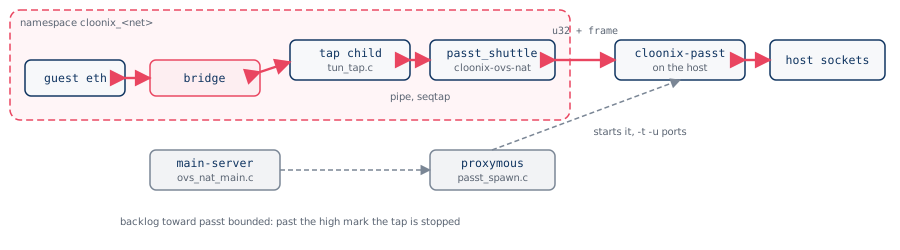
The nat item gives the guests of a lan the network of the host with no change on the host: no bridge, no iptables rule, no route. A frame of a guest crosses the bridge, the tap of cloonix-ovs-nat, a pipe to its parent (passt_shuttle.c), then the socket of a cloonix-passt running on the host as the user, as a 32 bit big-endian length and the frame. passt turns the frames into ordinary sockets of the host. proxymous starts that passt (passt_spawn.c), with -t and -u for the ports published to the guests.
The backlog towards passt is bounded; past its high mark the tap is no longer read, so the control link of the satellite is always served and its watchdog never starves.
3.8. The c2c
A c2c carries one lan of net A into net B, on the same host or another. First the signalling, over the doors port of B:
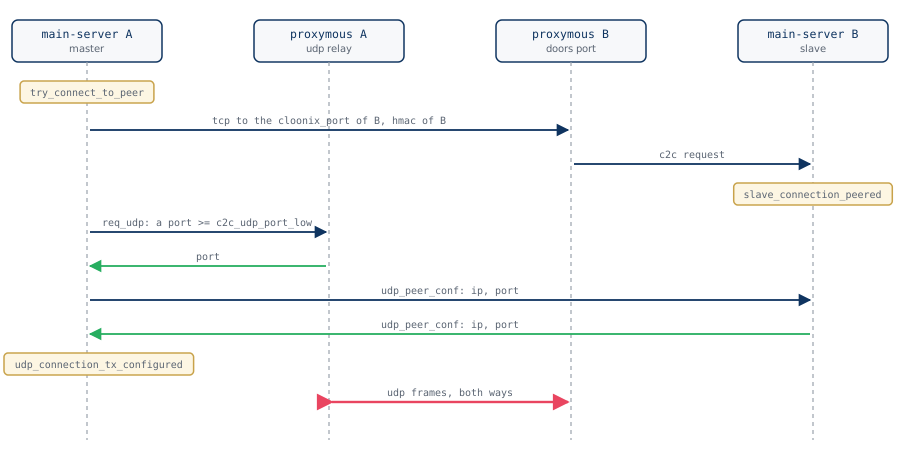
The master is the net where the c2c was created. It connects to the cloonix_port of the peer with the password of the peer, the peer creates its half, then each main server asks its proxymous for a udp port at or above c2c_udp_port_low and sends it to the other. The states are those cloonix cli <net> dump topo shows, state_master_try_connect_to_peer to state_udp_connection_tx_configured.
Then the frames, which never cross a main server:
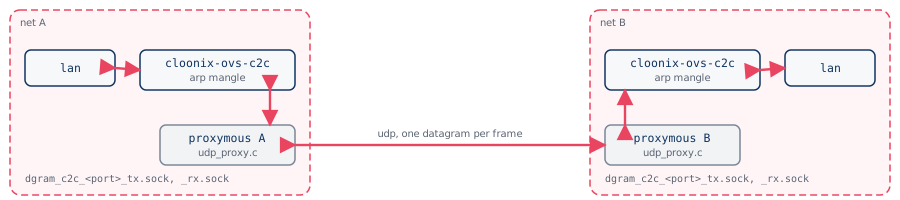
cloonix-ovs-c2c reads the bridge through its tap, rewrites the macs of arp and ip where the far lan needs it (packet_arp_mangle.c), and passes each frame on its datagram socket pair to proxymous, one udp datagram per frame. Five c2c relay at once at most (MAX_UDP_PROXY). A cut link is rebuilt by the master.
3.9. The life of a satellite
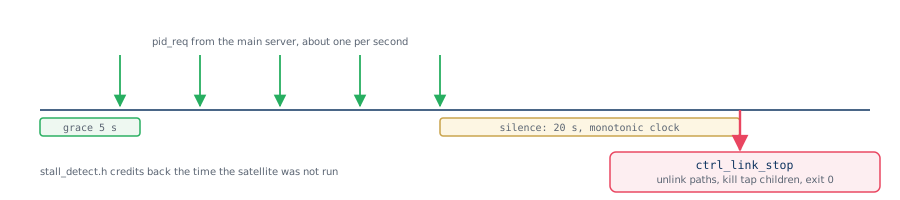
snf, a2b, c2c and nat share ctrl_link.c of lib_io_clownix: one listening socket for the main server, one live connection, one watchdog. The first pid_req must arrive within 5 s (CTRL_LINK_GRACE_MS), then one within every 20 s (CTRL_LINK_BEAT_MS). Every stop, watchdog, closed connection or kil_req, is the same ctrl_link_stop: the paths it registered unlinked, its tap children killed, one KERR line, exit 0.
Every silence judged between the main server and a helper is 20 s, so a host slowed for seconds by an extreme load breaks nothing:
CTRL_LINK_BEAT_MS     20000   ctrl_link.c       snf, a2b, c2c, nat: the main server
PROXY_WATCHDOG_MS     20000   ovs_nat_passt.c   nat: its proxymous leg
HEARTBEAT_LIMIT_MS    20000   ovs_drv.c         ovs-drv: the main server, 500 ms beats
C2C_PEER_SILENCE_MS   20000   ovs_c2c.c         the peer net of a c2c
3.10. The airs
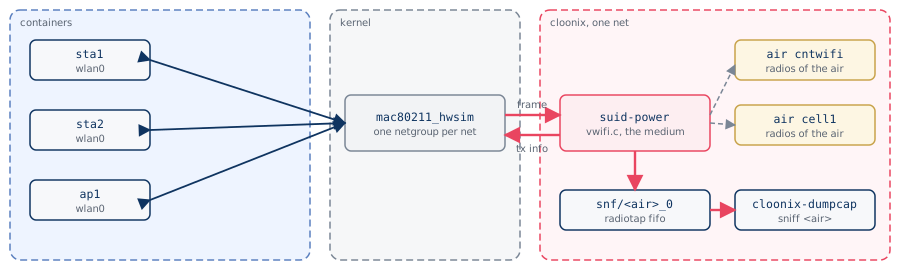
suid-power is the medium of every air (vwifi.c), cnt and kvm radios alike, in a process of its own, suid-power-air in ps, started by suid-power (air_proc.c): the commands suid-power runs for the containers block it, and a medium stopped for a second loses the beacons of its airs. A radio is created on a pipe that suid-power waits on; a delete, an air and a capture go on a second pipe, whose answers come back on it. A cnt radio of wlan= is a mac80211_hwsim radio made by suid-power from inside cloonix_<net>, so the radios of a net are a netgroup of their own, then moved into its container as wlan<n>. suid-power registers as the medium of that netgroup (HWSIM_CMD_REGISTER):
radio of sta1 --HWSIM_CMD_FRAME--> suid-power (vwifi.c)
   for each radio on the same air:  HWSIM_CMD_FRAME to a cnt radio,
                                    the air link to a kvm radio
   to the sender:                   HWSIM_CMD_TX_INFO_FRAME, acked when
                                    the frame is multicast or reached
                                    its receiver
   the frame, radiotap pcap:        snf/<air>_0
cloonix-dumpcap -i snf/<air>_0      started by the main server (wifi_air.c)
   <air>_0_pcap_sock, _pcap_fifo    sniff <air>, webshark
A frame or an address change from a radio deleted less than 10 s ago was queued before the delete and is dropped without a word; from any other radio unknown to the net it is a WARNING. A container being deleted holds no air: the main server stops counting its radios when the delete starts, as suid-power does.
The capture of an air is asked by cnf <air> sniff=on and lives as long as the air: an air that loses its last radio is gone with its capture, and comes back without one. suid-power writes the frames of a captured air only, and writes a pcap header each time it opens the fifo. A second sniff=on leaves a running dumpcap alone. A dumpcap that dies is started again one beat later, suid-power told first to close its writer, so the new dumpcap reads a fresh header; five deaths and the air is left uncaptured, with a WARNING.
A kvm radio is made by the agent in its guest. At each declaration of the backdoor of a kvm of wlan=N (wifi_air_kvm_radio), the main server tells suid-power each radio and its air, then doorways the radios:
cloonsuid_air_kvm name=<k> idx=<i> mac=<m+i> air=<air>    to suid-power,
                                "-" for no air; the radio made the first
                                time, answered cloonsuid_air_kvm_resp_ok
kvmwifi_on nb=<N> mac=<m>       to doorways, radio i takes m, last byte
                                plus i
cloonsuid_air_kvm_del name=<k>  to suid-power when the kvm dies
Doorways asks the agent on the answered pings until it says on or ko. The agent (cloonix_agent/src/wifi.c, raw generic netlink) loads mac80211_hwsim in the guest, gives the macs to udev with ID_NET_MANAGED_BY (in /run/udev/rules.d) and to an older networkd with Unmanaged=yes (in /run/systemd/network), makes the radios, wlan0 to wlan<N-1> in that order, and registers as the medium of the guest. Doorways relays the frames on the air link, a seqpacket socket <net dir>/air_link suid-power listens on and doorways connects to (glob_include/air_link.h); a message is its type, the kvm name, then the payload of the agent:
radio i of k1 --HWSIM_CMD_FRAME--> cloonix-agent of k1
   to the host:          header_type_wifi_frame: freq, rate, i, frame
   to the radio:         HWSIM_CMD_TX_INFO_FRAME, acked when the frame
                         is multicast or its receiver is a peer of
                         radio i
doorways (kvmwifi.c)     AIR_LINK_FRAME k1, the payload as it is
suid-power (vwifi.c)     to every other radio on the air of radio i,
                         cnt or kvm, a kvm one with the index of the
                         radio to give it to
                         the frame, radiotap pcap: snf/<air>_0
doorways (kvmwifi.c)     AIR_LINK_FRAME k2 j, to the agent of k2
cloonix-agent of k2 --HWSIM_CMD_FRAME--> radio j of k2
A kvm sender is acked by its agent without waiting: a unicast is acked when its receiver is on the air of the sender. suid-power keeps per radio its mac and further addresses, of a cnt radio its vifs, of a kvm radio the senders of its frames, probe requests aside, and tells each kvm radio the addresses of the other radios of its air (AIR_LINK_PEERS, relayed as header_val_wifi_peers) whenever they change, and to a radio moved to another air in any case. Doorways keeps the last list of each radio and tells it again to an agent back up. The agent adds to a radio's list the senders of the frames given to it, which came from its air, until the next list replaces it: a list late behind a first frame costs no ack. A list that reaches doorways before the ask of the switch is kept for the ask. A qmp reconnect drops the kvm in doorways and adds it again; a radio that had its list counts as gone for ten seconds, and its frames in that window are dropped without a warning. The air link may also speak of a kvm before its add, sent by the switch on another socket, reaches doorways: its peers are kept (early_note()) and given to it at its add (kvmwifi_born()); a name still unknown after ten seconds is a WARNING. A radio moved to another air stops being acked by the radios it left, so a station loses its access point as it would out of range. An agent that gets frames with no radio (restarted) answers wifi_off and is asked again.
No queue of an air grows without a bound, and the medium is never paused: one slow guest would stop every air of the net. A frame that finds its way full is dropped and counted, one WARNING per ten seconds, five in the agent:
cnt radio -> suid-power       mac80211_hwsim keeps a fixed number of
                              frames waiting for their tx status, which
                              suid-power gives after the delivery; a
                              netlink socket overflowed is lost frames
suid-power <-> doorways       the air link full, in either direction
doorways -> agent of k        the backdoor of k past msg_tx_queue_high()
agent of k -> doorways        the virtio port past 8 MB (VIRTIO_TX_HIGH)
suid-power -> dumpcap         the fifo of the capture full
dumpcap -> client, canvas     as for an eth, see A capture
A frame the agent drops is not acked, as on a busy air, and 802.11 sends it again; the kvm senders behind doorways are acked by their agent, so a drop there is a frame lost after its ack.
plug <guest> wlan<i> <air> is the air of a radio, any air for any radio: cloonsuid_air_cnt for a cnt, cloonsuid_air_kvm for a kvm, answered ok once suid-power has moved it, a ko after 3 s without the answer for a kvm. dump json carries the airs as vwif_air, dump commands replays those off the default air of the radio, cntwifi or kvmwifi.
The interface of plug, unplug, cnf and sniff is an int num on the wire. The client writes eth<i> as i and wlan<i> as WLAN_NUM_BASE + i (256, glob_common.h); the number of an item passes as it is. The main server turns wlan<i> into the number after the eths of the guest (wifi_air_num(), wifi_air.c) and writes an interface back as the user gives it (wifi_air_iface()), in dump commands and in its answers. A plain number past the eths of a guest is still a wlan: a 76 client sends it so.
Developer documentation ‹ 2. The logic behind the verbs › 4. The event loop and the rpc