User documentation ‹ 2. Cloonix among the network emulators › 4. Host system required customisation
3. Safety and attack surface
What an attacker can reach in a running cloonix, from where, and what stands in the way. Everything here is checkable in the source named beside it.
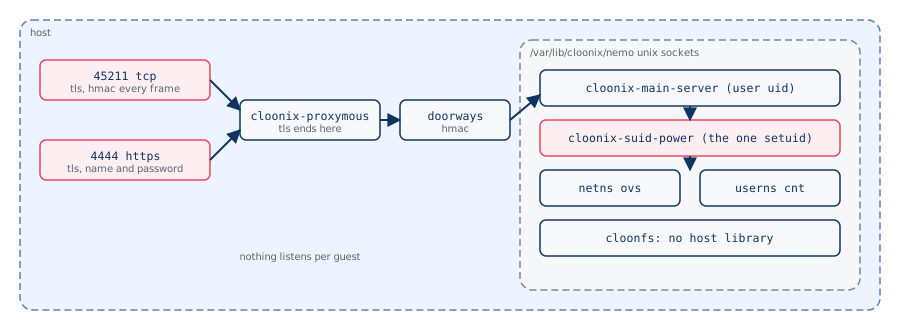
3.1. The map
Every way into a running net, in one table. the user is the account that started the net; in the toy every root of this table is that account.
entry |
who reaches it |
what stands in the way |
what passing it gives |
|---|---|---|---|
doors port 45211 |
anyone the address lets in |
the net password, an hmac on every frame, tls around |
the whole client: guests, a root shell in each, files in and out |
web port 4444 |
anyone, every address |
the same password, https, Origin equal to Host |
the canvas: the same, plus playing a demo, a program run as the user on the host |
c2c udp |
the peer net |
the port pair of the config |
ethernet frames into one lan |
nat |
the guest |
egress only, passt on the host as the user |
a way out to the internet; in only with publish= |
a guest, kvm |
whoever owns it |
qemu, running as the user once its devices are open |
the user's account if qemu is broken |
a guest, cnt |
whoever owns it |
a user namespace on the user's subuid window |
a subuid of the user |
the agent channel |
the guest |
parsed by the main server, as the user |
the user's account if the parser is broken |
cloonix-suid-power |
the user, or root, only |
SO_PEERCRED, a socket in a 0700 directory, a check on each verb |
qemu, crun, taps, a phy: what cloonix is for, bounded to files the user can open |
/var/lib/cloonix/<net> |
the user only |
0700 |
the launch scripts root runs |
/tmp/cloonix_proxymous_<net> |
the user only |
0700, owner checked at start |
the sockets between the daemons |
a local account that is not the user |
nothing of the net unless it holds the password |
the password is what keeps it out; the group cloonix keeps it from starting a net of its own |
with the password, the two ports as above; without it, nothing |
The rest of this chapter takes the lines of this table one by one; the section Hardening after the install is what to do about the last line and about the password.
3.2. Who is where
A running net is a set of processes on one machine. The account each one runs under is the whole of what a flaw in it can give away:
process |
bundle |
toy |
|---|---|---|
cloonix-main-server |
the user |
uid 0 of the crun = the user |
cloonix-doorways |
the user |
same |
cloonix-proxymous |
the user |
the user, on the host |
cloonix-gui-server |
the user |
uid 0 of the crun |
cloonix-ovs-drv, ovsdb-server, |
root |
uid 0 of the crun |
ovs-vswitchd |
||
cloonix-ovs-snf, -a2b, -c2c, |
root until the tap |
uid 0 of the crun |
-nat |
is open, the user for good after |
|
cloonix-suid-power |
root |
uid 0 of the crun |
cloonix-qemu-system |
root at start, the user once running |
uid 0 of the crun |
cnt guest |
the user's subuid window |
uid 0 of the crun |
the user is the account that typed cloonix start <net>. In the toy every uid 0 above is that account, mapped to 0 in a user namespace; the other ids of that namespace, when the toy has them, are the subuid window of the account: there is no root anywhere in a toy, whatever is broken.
To see it:
ps -eo user,pid,comm | grep cloonix
3.3. Who may run cloonix
In the bundle, as installed, every account of the machine may start a net: cloonix-suid-power, the one setuid binary, lets in anyone. The two copies of the configuration, /usr/libexec/cloonix/cloonfs/etc/cloonix.cfg and /usr/bin/cloonix_config.py, hold every net password and are readable by everyone, and so is the key of the https certificate.
One switch changes that: the existence of the group cloonix. Once it exists, cloonix-suid-power lets in root and its members, nobody else. The install does not create it; the section Hardening after the install does.
What a member is trusted with is what cloonix is for: qemu started as root for its tap and its namespace, a physical interface taken into a lan, a container built by crun. The section One privilege boundary lists what the root side accepts from such a member and what it refuses.
Source: suid_power/src/guard.c, guard_group_allows(); build_tools/install_cloonfs.
3.4. Two ports, nothing else
A net listens on two tcp ports and no other, both bound by proxymous with the same certificate:
cloonix_port      45211   tls, the client, cloonix-cxp-cli and the demos
cloonix_web        4444   https, name and password, on every address
No guest exposes a port. A shell into a guest, a file transfer and the topology feed are legs multiplexed on 45211; a desktop and a capture viewer are websockets on the web port. A firewall in front of cloonix opens one port for the command line and one for the browser.
To see it:
ss -ltnp | grep cloonix
The password is the perimeter. Whoever holds cloonix_passwd of a net drives it: adds and deletes guests, opens a root shell in any of them, plays a demo, which is a program run on the host in the account of the net owner. The passwords shipped in cloonix_config.py are in every copy of the tarball; cloonix start says so at every start of a net that still uses one, and install_cloonfs repeats it. Change them before a port is reachable by anyone but yourself.
3.5. The doors port: tls around, an hmac on every frame
Who is talking. Every doors frame carries a 32 byte hmac-sha256 of its payload, keyed by cloonix_passwd. cloonix-doorways checks it on every frame, in both directions, in constant time, and closes the connection on a mismatch. Without the password nothing a client says is acted on.
Who is listening. The tcp connection is wrapped in tls, ended in cloonix-proxymous with the certificate of the https port, so the frames cross the network encrypted. The certificate is self-signed and the client does not verify it: tls is there for the confidentiality only, the hmac above is what authenticates.
3.5.1. Two dialects on one port
proxymous reads the first byte of every new connection and serves both:
0x16    a tls client hello: the handshake is done in proxymous, and
        doorways receives the decrypted frames
0xCA    a doors frame in clear: handed to doorways as it is
The cloonix client and cloonix-cxp-cli both try tls first. A server that closes the socket during the handshake, a release before this one or one without a certificate, is spoken to again in clear, and both print one line when they do:
cloonix: 192.168.1.9:45211 does not speak tls, the connection is not encrypted
With CLOONIX_REQUIRE_TLS=1 in the environment they refuse instead of falling back, so a server that can be made to fail the hello from outside cannot obtain the frames in the clear. The clear form is still what the c2c leg between two nets sends.
cloonix-cxp-cli takes the password from the environment variable CLOONIX_PASSWD when its second argument is -, which is how the gui server and the toy start it: the password never appears in the process list.
Source: proxymous_passt/src/set_config.c, proxy_tls.c, lib_io_clownix/src/doorways_sock.c, cxp_cli/src/cloonix_cxp_cli.c, cloonix/cloonix function tls_connect.
3.6. The web port
https only. The port asks for http basic credentials: the net name as user, its cloonix_passwd as password, compared in constant time. A wrong password is answered after one second, one connection per guess. Basic is the one scheme a browser applies by itself to a websocket handshake, so the console panels carry the credentials without a token in any url.
Every request has its Origin compared with its Host. A page open in the browser on another site cannot drive a cloonix on this machine.
The certificate is self-signed, made once at packing time and shipped in the tarball; a net that finds none makes its own at its first start. Its key is as public as the tarball: replace it on anything but a private lab machine:
sudo cp my_cert.pem /usr/share/cloonix/cert/cloonix_cert.pem
sudo cp my_key.pem  /usr/share/cloonix/cert/cloonix_key.pem
or point CLOONIX_TLS_DIR at a directory holding the pair. The installed key is readable by everyone until the post-install step below limits it to the group.
Source: jscloonix/jscloonix/web/web_auth.c, web_http.c.
3.7. What a browser cannot do
Run bytes it sent. A demo is played by name; the gui server hands that name to proxymous, which runs the file from /usr/share/cloonix/demos on the host. A name that is not there, or a net without proxymous, gets a KO and nothing runs. The text sent with the name is only looked at for its shebang.
Write a file. The pcap recorder writes under /usr/share/cloonix/pcap and nowhere else, and every name a browser sends that becomes part of a path is checked by web_name_ok: no separator, no .., no leading dot.
Get a shell on the host. The console urls name a guest and one of three kinds; anything else is refused before any fork.
Replace a shipped demo. /usr/share/cloonix/demos is sticky (1777) and the shipped tree belongs to root, writable by root only: a user saves demos under names of their own and cannot rewrite frrspider.py for the next user who presses Play.
What a browser can do, with the password, is play a demo of its choice among those on disk, which is a program run as the net owner, and open a root shell in every guest. That is the intended use of the port.
3.8. One privilege boundary
One binary of the delivery is setuid root: cloonix-suid-power. It is started by the main server, reachable through a unix socket in /var/lib/cloonix/<net>, mode 0600 and owned by the net owner, and every connection is checked with SO_PEERCRED: the net owner or root, nobody else. It speaks a fixed vocabulary, and each verb is bounded on the root side, whatever the caller writes:
request |
what root does, and the check on it |
|---|---|
cloonsuid_req_launch |
starts dtach -n <sock> bash <script>: the dtach and the bash are the pinned ones of cloonfs, the socket and the script are inside /var/lib/cloonix/<net>, the script belongs to the caller and holds the two lines the main server writes, on the pinned nsenter and qemu; every file named on the qemu line is one the caller can open with their own uid |
cloonsuid_req_vm_kill |
SIGKILL of a qemu started here |
cloonsuid_req_pid_kill |
SIGKILL of a process of the caller's uid, or of a process of this net; any other pid is refused |
cloonsuid_req_phy |
the list of physical interfaces |
cloonsuid_req_ovs |
ovs-vsctl read commands from a fixed list, no option token, no shell character |
cloonsuid_req_spawn |
one of the five ovs satellites, by its full path in the installed bin dir, arguments of identifier characters only |
cloonsuid_req_suidroot |
takes root back for the verbs above |
cloonsuid_crun_create_net |
a container in a user namespace; one without, which would be host root, is refused outside the toy |
erase_workdir (argv) |
removes /var/lib/cloonix/<net> when the caller owns it |
The bin dir and the work dir are not taken from the command line: the first is the installed one, the second is /var/lib/cloonix/<net>, and a start with anything else stops. There is no "run this command" among the verbs. Every name that becomes a path or an argument is checked by name_is_sane(): letters, digits, underscore, dash, dot, no leading dash or dot, no ...
qemu is started as root because a tap in a namespace needs it, and is given -run-with user=<uid>:<gid> so that once its devices are open it is a process of the net owner. A guest escaping qemu lands in that account, not in root.
The ovs satellites, cloonix-ovs-snf, -a2b, -c2c, -nat, carry no setuid bit: suid-power starts them as root, they enter the namespace and open their tap, then drop to the net owner with cloonix_drop_root(), real, effective and saved ids together, before they read a byte from the network. A c2c peer or a nat flow talks to a process of the user. cloonix-ovs-drv and the two openvswitch daemons it runs stay root: the bridges are kernel objects and the datapath needs it.
To see it:
find /usr/libexec/cloonix -perm -4000
ps -o user,pid,args -C cloonix-qemu-system
Source: suid_power/src/suid_power.c, guard.c, crun.c.
3.9. Directories
/var/lib/cloonix           1777   any user creates a net dir, only the
                                  owner removes or renames it
/var/lib/cloonix/bulk      777    images shared and rebuilt by anyone;
                                  1777 after the post-install step; a
                                  <n>_targz tree extracted from <n>.tar.gz
                                  by the main server, as the user; mounted
                                  read only for every container
/var/lib/cloonix/<net>     0700   the launch scripts and config.json that
                                  root runs are inside: the owner only
/tmp/cloonix_proxymous_<net>  0700  the sockets between the daemons of a
                                  net; owned by the user, or the net
                                  does not start
/usr/share/cloonix/demos   1777   shipped demos root, 644
/usr/share/cloonix/pcap    1777
/usr/share/cloonix/cert    644, group only after the post-install step
cloonfs/etc/cloonix.cfg    644, group only after the post-install step
/usr/bin/cloonix_config.py 644, same
A name that is known in advance under /tmp is a name another account can create first; the main server and proxymous both refuse a directory that exists and belongs to someone else.
Source: build_tools/install_cloonfs, suid_power.c function run_dir_create, uml_clownix_switch.c function mk_and_tst_work_path, proxymous_passt/src/main.c.
3.10. Namespaces
The lans, the guest interfaces and the ovs daemons live in the network namespace cloonix_<net>. The host sees no interface of a running net, and two nets on one machine cannot collide.
A cnt runs in a user namespace: container uid 0 is the user running cloonix, container 1 upward is that user's subuid range, which cloonix-suid-power adds to /etc/subuid and /etc/subgid when the user has none. The image is mounted idmapped for each container -- its owner seen as that user, the owner's window as his -- so bulk is never modified by cloonix and one image serves several users at once. A net started by root gets no container rather than one without a user namespace.
There is no privileged container in the bundle: no flag asks for one, and cloonix-suid-power refuses the request outside the toy. In the toy every container is one, and its uid 0 is the user.
The toy runs the whole of cloonix inside a crun of the user's own uid: root inside it is the user on the disk.
To see the namespaces of a container:
cloonix cli nemo trace nspace
3.11. Guests
A guest image contains no cloonix: no agent, no library, no binary. The agent comes on a cd-rom built by cloonix, insider_agent_.iso*.
A shell into a guest uses no ip address of the guest: the bytes travel on a virtio serial port for a kvm, on a shared mount for a cnt.
The directory transfer of cloonix cli <net> scp -r refuses member names that are absolute or contain .., on both sides of the wire.
The nat is egress only unless a port is published with publish=.
What a guest sends back on its agent channel is parsed by the main server, a process of the net owner: a hostile guest talks to that account, not to root.
3.12. No host library
Every binary of cloonfs has its interpreter and rpath rewritten to cloonfs with patchelf. A vulnerable library of the host is never loaded by cloonix, and a vulnerable library of cloonix is never loaded by the host.
To see it:
readelf -l /usr/libexec/cloonix/cloonfs/bin/cloonix-main-server | grep interpreter
readelf -d /usr/libexec/cloonix/cloonfs/bin/cloonix-main-server | grep RPATH
3.13. Hardening after the install
The install leaves cloonix open: every account starts a net, the passwords and the key are readable, a client falls back to clear. Each of the seven steps below closes one of those, and each is optional: a private machine with one user needs none of them.
3.13.1. One: change the passwords
The cloonix_passwd of every net is in cloonix_config.py of the tarball, so it is public: the name of the net followed by clown. For the net nemo: user nemo, password nemoclown. Edit /usr/bin/cloonix_config.py and /usr/libexec/cloonix/cloonfs/etc/cloonix.cfg, the same text twice, one line per net:
cloonix_passwd nemoclown
Every client of the net, on this machine or another, uses the same file, so the edited file is what to hand out. cloonix start says at every start whether a net still runs with a shipped password.
3.13.2. Two: the group cloonix
sudo groupadd cloonix
sudo usermod -aG cloonix bob
From the groupadd on, cloonix-suid-power refuses every account that is not root or a member. The check reads /etc/group at each start, so bob starts a net the second the usermod is done, in any terminal, including the one he is sitting in. Adding and removing others:
sudo usermod -aG cloonix alice
sudo gpasswd -d alice cloonix
Deleting the group turns the gate off again:
sudo groupdel cloonix
3.13.3. Three: limit the passwords and the key to the group
sudo chown root:cloonix /usr/bin/cloonix_config.py \
                        /usr/libexec/cloonix/cloonfs/etc/cloonix.cfg \
                        /usr/share/cloonix/cert/cloonix_key.pem
sudo chmod 640          /usr/bin/cloonix_config.py \
                        /usr/libexec/cloonix/cloonfs/etc/cloonix.cfg \
                        /usr/share/cloonix/cert/cloonix_key.pem
From then on a local account outside the group sees neither the passwords nor the key.
A process gets its groups once, at login: a shell opened before the usermod does not carry cloonix, and no command it runs can add it. The daemons and the client read these files with the groups of the shell, so that shell stops on permission denied; cloonix-suid-power reads /etc/group itself, which is why step two needs no new terminal. id shows whether a shell carries the group; one that does not gets it without a new login:
newgrp cloonix                      a child shell carrying the group
sg cloonix -c "cloonix start nemo"  one command carrying the group
The client says so when it finds cloonix_config.py unreadable:
cloonix_config.py is there but not readable by this shell: it is limited
to the group cloonix, and a session opened before you were added to
that group does not have it. Open a new terminal, or run:
  newgrp cloonix
A reinstall rewrites the three files at 644, so the chown and chmod above are redone after one; the group and its members are kept, /etc/group is not touched by rm -rf /usr/libexec/cloonix.
3.13.4. Four: only the owner removes an image
sudo chmod 1777 /var/lib/cloonix/bulk
Sticky, like /tmp: an image is still readable and usable by every net, but only the account that made it can remove or rename it. Rebuilding an image made by another account then needs that account, or a chown of the image.
3.13.5. Five: refuse the clear fallback
In the environment of the shell that runs the client, and of the gui server when its consoles reach a remote net:
export CLOONIX_REQUIRE_TLS=1
A server that does not answer the tls hello is then refused rather than spoken to in clear.
3.13.6. Six: your own certificate
The shipped key is as public as the tarball. Replace the pair, then limit the key as in step three:
sudo cp my_cert.pem /usr/share/cloonix/cert/cloonix_cert.pem
sudo cp my_key.pem  /usr/share/cloonix/cert/cloonix_key.pem
A browser that had accepted the previous certificate asks again once.
3.13.7. Seven: the ports
cloonix_ip in the config is the address the doors port binds; 127.0.0.1 keeps the command line on this machine. The web port listens on every address: a firewall in front of it opens 4444 to the addresses that need the canvas and nothing else.
3.14. What is not protected
Until the group exists, every local account starts a net; until step three above is done, every local account reads the net passwords and the key of the certificate.
A net owner is trusted with the host interfaces: a phy item puts any physical interface of the host into a lan.
The c2c leg between two nets and its udp travel in clear.
A client speaking plain frames on the doors port is still served by the server; it is the client that refuses to speak plain to a remote net.
The key of the shipped certificate is public until replaced.
The password is one string per net, in a file; there is no account, no audit of who used it.
qemu opens its devices and disks as root before dropping; a flaw in that first second is a flaw in root.
cloonix-ovs-drv, ovsdb-server and ovs-vswitchd are root for the life of the net; their sockets are in the net directory, mode 0700.
User documentation ‹ 2. Cloonix among the network emulators › 4. Host system required customisation