User documentation ‹ 1. Software Release Information › 3. Safety and attack surface
2. Cloonix among the network emulators
Four other tools build a network of machines on one computer. This chapter puts cloonix beside them, point by point, on what each one is made of and what a user of it does. Nothing here is a benchmark; every line about cloonix is checkable in the chapters that follow.
tool |
what it is made of |
|---|---|
gns3 |
a qt gui and a python server; the guests are the qemu, docker, virtualbox and vmware of the host or of the gns3 vm, plus dynamips and iou for cisco images; the links are udp relays held by ubridge |
eve-ng |
an ubuntu system, installed on a machine or as a vm, with a web gui; the guests are qemu, docker, iol and dynamips; the links are bridges of that system |
containerlab |
one binary driving the docker or podman of the host; the guests are containers, a kvm guest is a qemu run inside a container; the links are veth pairs |
mininet |
a python library; the guests are network namespaces of the host kernel, the switches openvswitch or the linux bridge; made for openflow controllers |
cloonix |
C daemons and one python client; qemu-kvm, openvswitch, crun, passt and the wireshark dissectors are compiled into the delivery; the guests are kvm and cnt, the links are openvswitch bridges |
2.1. Nothing from the host
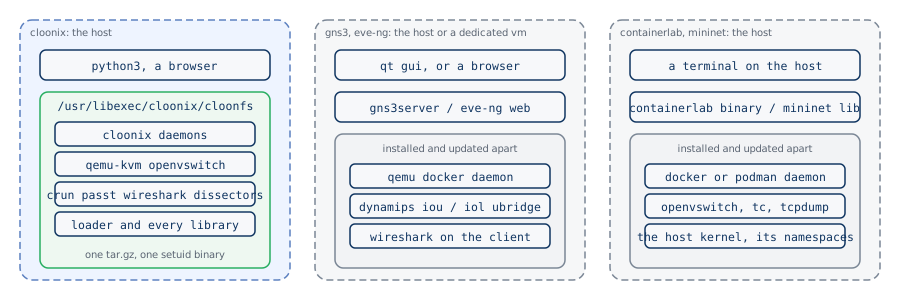
Every binary and library cloonix uses is under /usr/libexec/cloonix/cloonfs, interpreter and rpath rewritten by patchelf at packing time. The host has no qemu, no openvswitch, no docker, no crun and no wireshark to install, and the version of each is the one of the tarball, whatever the distribution. One tar.gz runs on debian, fedora and arch, and on a release later than the build. Removing /usr/libexec/cloonix removes it.
gns3 and containerlab drive a hypervisor and a container engine that are installed and updated separately, either on the host or in the gns3 vm; eve-ng is a whole operating system. mininet uses the kernel of the host as the only kernel.
To see it:
ls /usr/libexec/cloonix/cloonfs/bin
readelf -l /usr/libexec/cloonix/cloonfs/bin/cloonix-qemu-system | grep interpreter
2.2. Root once, or never
The bundle asks for root once, at install, and runs as ordinary processes of the user afterwards; the toy asks for root at no moment, install or run: cloonix itself runs in a crun of the user's own uid. The one setuid binary of the bundle, cloonix-suid-power, speaks a fixed vocabulary and is listed, verb by verb, in the chapter Safety and attack surface.
A gns3 or a containerlab user is a member of the docker group of the host, or root, to reach the daemon; eve-ng runs its nodes as the root of its system.
To see it:
find /usr/libexec/cloonix -perm -4000
ps -eo user,comm | grep cloonix
2.3. The cable is a switch
The one thing a port plugs into is a lan, an openvswitch bridge that learns: a frame whose destination is known leaves by one port, a broadcast or an unknown one by every other port. A cable between two machines is a lan with two ports; a segment with ten machines is the same lan with ten. A capture on a port that is not on the path shows arp and broadcast and no unicast, which is what a real switch shows.
In gns3 and containerlab a link joins two ports and a switch is a node, added and cabled like a machine. In mininet a switch is an openflow switch driven by a controller.
cloonix cli nemo plug pc eth0 lan1
cloonix cli nemo plug r1 eth0 lan1
cloonix cli nemo dump ovs-vsctl show
2.4. A shell without an address
cloonix cli nemo ssh r1 opens a root shell in the guest over a virtio serial port for a kvm, over a shared mount for a cnt. scp and files travel the same way. The guest has no management interface, no ip address reserved for the tool and no daemon of the tool listening on its network: the topology holds the interfaces of the model and nothing else, and a guest with every interface down is still reachable.
gns3 and eve-ng reach a guest by its console, a telnet or a vnc port of the server; containerlab plugs every node into a management docker network and reaches it by ssh on that network.
cloonix cli nemo ssh r1 "ip -br addr"
cloonix cli nemo scp /tmp/f r1:/root/
cloonix cli nemo files r1
2.5. The capture is in the switch
A sniff is a subscription on one interface with a capture filter, and the filter is applied by cloonix-ovs-snf in the switch: only the packets that match leave the namespace. The same packets open in webshark, the dissection engine of wireshark in the browser, with no wireshark on the client. Two sniffs with one filter on the two sides of a tunnel show what was encrypted or dropped.
gns3 writes a pcap file that a wireshark installed beside the gui opens; containerlab and mininet run tcpdump in the namespace of the node.
cloonix cli nemo sniff r1 eth1 --dump udp port 53
2.6. A cable that degrades
a2b is an item, cabled like a machine: loss, delay, rate and silentms, each direction apart, from the command line or from sliders in the right-click menu of the canvas, on a running network.
gns3 sets a filter on a link, containerlab and mininet call the netem of the host kernel on a link.
cloonix cli nemo add a2b cable
cloonix cli nemo cnf cable A2B delay=100
cloonix cli nemo cnf cable B2A loss=100
2.7. One net, several machines, the real world
c2c cables a lan of this net to a lan of a net on another computer, over one udp port pair: a topology spread on two machines is two demos and one add c2c.
phy puts a physical interface of the host into a lan, taken away from the host or as a macvlan on it; tap gives the host an interface into a lan; nat gives the guests a way out to the internet through passt, egress only unless a port is published.
A net lives in its own network namespace, cloonix_<net>: the host sees no interface of it, and two nets on one machine do not collide.
cloonix cli nemo add c2c nemo2fido fido
cloonix cli nemo add phy enp6s0 --macvlan
cloonix cli nemo add nat nat1
2.8. The guest is a stock image
A kvm boots a plain qcow2 of bulk and a cnt runs a plain directory, or the tar.gz of one, extracted at its first use: nothing of cloonix is inside, the agent arrives on a cd-rom built by cloonix. A cloud image of a distribution is used as downloaded; a windows, a freebsd and a cisco ios-xe disk have a verb each, add win, add freebsd, add cisco, which adds what that disk always needs. A cnt runs in a user namespace on the user's subuid window, its image mounted idmapped, so one image in bulk serves several users and several nets at once and is never written by cloonix.
gns3 and eve-ng ship a catalogue of appliance definitions, one per vendor image, and run cisco ios of the old routers under dynamips, which cloonix does not: the cisco guest of cloonix is the catalyst 8000v under qemu.
cloonix cli nemo add kvm r1  ram=2000 cpu=2 eth=2 trixie.qcow2
cloonix cli nemo add cnt pc  eth=1 trixie
cloonix cli nemo add win Win1 ram=4000 cpu=2 eth=1 win.qcow2
2.9. The topology is a program
A network is the sequence of add lines that built it, and a demo is that sequence in a python file with the acts that follow: a routing daemon started, a packet caught, a link cut. 69 demos are in /usr/share/cloonix/demos, one file each, played by name from the command line or from the canvas, each running the daemon a carrier runs, frr, keepalived, wireguard, nftables, kea, bind, asterisk, mosquitto, postfix, on a topology that costs the seconds it takes to boot.
gns3 keeps a project file, eve-ng a lab file, containerlab a yaml file; cloonix has no topology file format: dump commands prints the command lines that rebuild the running net, settings and places included, and that output is a shell script; save writes a running kvm back to a qcow2.
cloonix cli nemo demo routing
cloonix cli nemo demo routing frrspider
cloonix cli nemo dump commands > mynet.sh
2.10. The client is one file
The client is one python file on the standard library, with a helper file per large verb, run as it is on linux, macos and windows; the canvas is a web page on the https port of the net, with the root shells, the desktops and webshark as panels of that page. Nothing is installed on the client side but python, or a browser.
The gns3 gui is a qt application to install on the client, with its web gui as the other way in; eve-ng is a browser; containerlab and mininet are a terminal on the server.
cloonix list
cloonix cli nemo ssh r1
2.11. Two ports, one password
A net listens on two tcp ports, 45211 for the client with tls and an hmac on every frame, 4444 for the browser with https and basic auth, and on no other: no guest exposes a port. Whoever holds the password of a net drives it; there is no account and no audit. The chapter Safety and attack surface takes every way in one by one.
To see it:
ss -ltnp | grep cloonix
2.12. What cloonix does not have
no dynamips, iou or iol: no ios image of the old cisco routers
no virtualbox and no vmware guest
no catalogue of vendor appliances: an image is a qcow2 or a directory put in bulk
no topology file format: a net is saved as the shell script dump commands prints
no accounts, one password per net
no openflow controller and no sdn switch: a lan is a learning bridge
User documentation ‹ 1. Software Release Information › 3. Safety and attack surface