User documentation ‹ 17. Details on ovs ports creation › 19. A windows guest
18. Building the guest file-systems
Cloonix ships no guest. The server looks for them in bulk and refuses a machine whose root file-system is not there; the refusal names the script of vm_create that builds it, cnt_kvm/kvm_<n>.sh or cnt_kvm_demo/kvm_<n>.sh for <n>.qcow2, cnt_kvm_demo/cnt_<n>.sh or cnt_kvm/cnt_<n>.sh for a directory <n>, and the download at clownix.net.

/var/lib/cloonix/bulk/<name>.qcow2      a kvm guest
/var/lib/cloonix/bulk/<name>/           a cnt guest, a directory holding /sbin/init
/var/lib/cloonix/bulk/<name>.tar.gz     a cnt guest too, when the directory is absent
/var/lib/cloonix/bulk/<name>_targz/     what cloonix extracted from it, never to be modified
Two ways to fill it: download, or build with vm_create.
18.1. Downloading
mkdir -p /var/lib/cloonix/bulk
cd /var/lib/cloonix/bulk
wget https://clownix.net/downloads/kvm_bulk/trixie.qcow2.gz
gunzip trixie.qcow2.gz
wget https://clownix.net/downloads/cnt_bulk/trixie.tar.gz
The tar.gz is used as it is: with no trixie directory beside it, the first add cnt on trixie extracts it into trixie_targz for every net of the machine. Unpacked by hand, with tar xvf, the directory comes first and takes --persistent. Either way a container sees the image with its owner's ids translated into those of the user who started the net.
18.2. The _targz trees
A <name>_targz tree is the content of <name>.tar.gz and stays it:
trixie.tar.gz        the image, downloaded or built
trixie_targz/        its extraction, made by cloonix, the same for every
                     net and every user of the machine
Cloonix never writes in it. Each container gets it mounted read only, under an overlay: the writes of the guest go to a tmpfs that is dropped with the container, and a write through the mount is answered Read-only file system by the kernel.
--persistent is refused on the tar.gz and on any name ending in _targz.
The modes inside are those of the archive, write bits included: they are part of the image, the guest sees them through the overlay, and a daemon that leaves root, named -u bind for one, needs its directories writable. So the modes do not protect the tree on the host: its owner is asked not to edit it. A change made there reaches every container started afterwards, on every net, and the tree no longer matches its tar.gz.
rm -rf trixie_targz is the repair: the next add cnt extracts the archive again.
An image to modify, or to run with --persistent, is a directory of another name, made from the archive or copied from the tree:
cd /var/lib/cloonix/bulk
mkdir mytrixie && tar xpf trixie.tar.gz -C mytrixie
cloonix cli nemo add cnt cnt1 eth=1 mytrixie --persistent
or:
cp -a trixie_targz mytrixie
A directory named trixie, without the suffix, comes before trixie.tar.gz for every add cnt ... trixie of the machine.
18.3. What vm_create contains
vm_create/get_distro     mirrors a distribution onto a local disk
vm_create/cnt_kvm        the distributions: one cnt and one kvm per distro, the desktops
vm_create/cnt_kvm_demo   the demo images: trixie plus one piece of software, and
                         the kvm images a demo needs beyond the distributions
vm_create/cisco          the Catalyst 8000V image, from a cisco iso
Nothing in them uses sudo except check_www_links.sh. Every builder runs inside a user namespace and writes into bulk only.
18.4. A local mirror first

The builders install from a web server on your own machine, never from the internet. freebsd has no mirror, so doitall.sh does not build it: kvm_freebsd.sh is run by hand. One script per distribution in get_distro: get_trixie.sh, get_rocky.sh, get_fedora.sh, get_alpine.sh, get_arch.sh, get_opensuse.sh, get_resolute.sh, get_noble.sh. The paths at their top point at the author's disk:
hote="ftp.fr.debian.org"
cible="/media/perrier/T7Shield2/distros/trixie"
Then the symlinks under /var/www/html:
sudo ./check_www_links.sh
curl http://127.0.0.1/trixie/
Two addresses are written into the images: http://127.0.0.1/<distro> used while building, and http://10.117.0.1/<distro> inside the finished image, which a guest cabled to a nat reaches, so apt install works from inside a topology.
18.5. Building without root
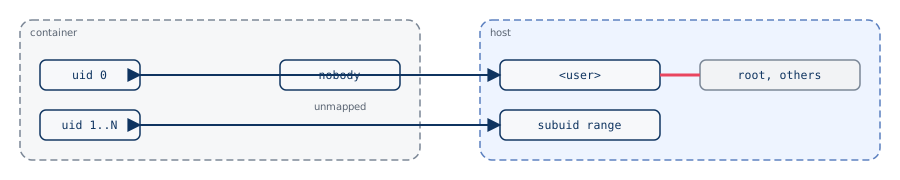
Every builder re-executes itself through:
unshare --map-root-user --user --map-auto --mount -- ...
Inside, the builder is uid 0, so mmdebstrap, dnf, pacman, mkfs.ext4 and chroot work. Seen from the host the files belong to the subuid range of your account, from /etc/subuid and /etc/subgid. A tree built that way is erased from the same kind of namespace:
unshare --map-root-user --user --map-auto -- rm -rf /var/lib/cloonix/bulk/trixie
A guest runs in a user namespace too: container uid 0 is the user running cloonix, container 1 upward is the subuid window. Files whose owner or group land outside that map show as nobody:nogroup in the guest and cannot be written, chowned or listed by container root, whatever its capabilities. setgroups is refused for the life of the namespace, and chown to an id outside the map answers EINVAL. A package that creates a user, frr with /etc/frr, is handed back to root at the end of its builder, and the demos tell such daemons to stay root. Check an image with:
find /var/lib/cloonix/bulk/<image> ! -user $(id -u)
18.6. The driver: doitall.sh
cnt_kvm/doitall.sh:
./doitall.sh                 the help, builds nothing
./doitall.sh --cnt           every container image
./doitall.sh --kvm           every base machine image, no desktop
./doitall.sh --cnt --kvm     both
./doitall.sh --cnt --kvm trixie rocky
./doitall.sh --desktop       the desktop machines
./doitall.sh --all           everything
./doitall.sh --list          what would be built
cnt_kvm_demo/doitall.sh, keyed by the demo name, frr for the three frr demos; realnet is its one kvm image, python_trixie.qcow2, built by kvm_python_trixie.sh under a running cloonix:
./doitall.sh                 the help
./doitall.sh --all           every image every demo needs
./doitall.sh frr             frr_trixie
./doitall.sh ipsec           both swans
./doitall.sh realnet         python_trixie.qcow2
./doitall.sh dns dhcp
./doitall.sh --list
Before building, both check: not root, known names, scripts present and executable, none calling sudo, bulk writable, unshare, flock, mkfs.ext4 and qemu-img installed. Containers are built first. Each build writes a log:
/tmp/doitall-logs/cnt_trixie.log
/tmp/doitall-logs/kvm_trixie.log
A failure stops the run and names the log and the retry, ./doitall.sh --cnt trixie. Every container builder ends by calling cnt_common_config from cnt_kvm/cnt_common.sh: syslog configuration, locale.gen, locale.conf, /etc/hosts, root present in passwd and group.
18.7. Everything at once: allbulk.sh
vm_create/allbulk.sh runs both drivers with --all, one after the other, and delivers what they built into four directories of the home, ready to be published or copied to another machine:
./allbulk.sh                 the help and the names, builds nothing
./allbulk.sh --go            hours: every image of both directories
./allbulk.sh --deliver       no build: deliver what bulk holds

cnt_kvm/doitall.sh --all        ~/cnt_bulk/<image>.tar.gz
                                ~/kvm_bulk/<image>.qcow2.gz
cnt_kvm_demo/doitall.sh --all   ~/cnt_demo_bulk/<image>.tar.gz
                                ~/kvm_demo_bulk/<image>.qcow2.gz
A container image is copied as it is, a qcow2 is gzipped, with pigz when
the machine has it; the images stay in bulk. It stops at the first error: a
builder that fails, a listed image that is not in bulk, or one that this run
did not build. After such a stop the failed builder is corrected and run
alone, ./doitall.sh --desktop alpine as the failure says, the rest is
built with the two drivers, and --deliver finishes the work without
building anything again. What goes to each directory is what the --list of its
driver names, the desktops included, not what bulk happens to hold. A
delivered machine image is put back in use with
gunzip -c trixie.qcow2.gz > /var/lib/cloonix/bulk/trixie.qcow2.
18.8. Building a container image
cnt_<distro>.sh builds a directory and delivers it as <distro>.tar.gz in bulk, the directory erased, by cnt_common_pack of cnt_common.sh: the tree is packed from the user namespace it was built in, so its owners read 0 upward inside the archive. The package list of the debian one: adduser, iproute2, iputils-ping, net-tools, procps, rsyslog, tcpdump, strace, vim, kmod, and for the wifi demo iw, hostapd, wpasupplicant. No dbus: nothing starts it in a container without an init, and a package that needs the library pulls it in on its own.
The debian images carry no systemd; trixie_systemd, built by cnt_trixie_systemd.sh, is the one with an init for the demos that need one. On rocky, fedora, tumbleweed and arch systemd comes with the base and is never started unless asked. A syslog daemon is in every image, rsyslog everywhere but arch, where it is syslog-ng; cloonixsbininit starts whichever it finds, so a container keeps a /var/log/syslog, readable from the host under /var/lib/cloonix/<net>/cnt/<n>/rootfs/var/log/.
cd vm_create/cnt_kvm
./cnt_trixie.sh                                 writes bulk/trixie.tar.gz
cloonix cli nemo add cnt cnt1 eth=1 trixie      extracts it at this first use
A cnt_ script refuses to run if its target directory or tar.gz exists; doitall.sh erases both, and the _targz tree a net extracted from the previous archive, before a rebuild.
The demo images:
cd vm_create/cnt_kvm_demo
./cnt_frr_trixie.sh          bulk/frr_trixie.tar.gz: trixie plus frr and frr-pythontools
No configuration is baked into a demo image: the demo writes the daemons file, frr.conf, keys, zones and rulesets at run time over cloonix cli ssh, so one image serves several demos and no key ends in a tarball.
18.9. Building a virtual machine image
kvm_<distro>.sh assembles a kernel, an initramfs, a bootloader, a partition table and a file-system without a loop device and without mounting anything: mkfs.ext4 -E offset= -d writes the file-system into the image at the right offset, grub-bios-setup takes the image path, and grub.cfg is written by hand.

The build ends with two checks: the boot signature 55 aa in the first sector, and a non-zero BIOS boot partition at sector 2048. The previous image is kept as <name>.qcow2.prev until the new one is written. A lock on /var/lib/cloonix/bulk refuses two image builds at once, whoever runs them. The scripts write nothing beside themselves: any user runs them from anyone's tree. KEEP_TREE=1 keeps the intermediate tree and skips the bootstrap on the next run:
KEEP_TREE=1 ./kvm_trixie.sh
What the builders put in a machine image:
qemu-guest-agent enabled          cloonix drives it to start its agent
virtio modules forced at boot     /etc/modules-load.d/virtio.conf
wait-online units masked          no 90 s stall when no dhcp answers
a getty on ttyS0                  the Console panel
no periodic fsck
root password root
a user named user, password user  trixie, resolute, arch; and every desktop,
                                  whose builder creates it when the base has none
kvm_freebsd.sh is the exception to the mirror rule, and for that reason not one of the builders doitall.sh runs: it is called by hand. It takes the disc1 iso of FreeBSD 15.1 from download.freebsd.org, installs the base system from the packages that disc carries with bsdinstall driven by an installerconfig, and fetches one package, qemu-guest-agent. The serial console is turned on by the rebuilt iso and by the post-install script.
To test an image outside cloonix with the cloonix qemu, console on the terminal, Ctrl-a then x to leave:
./tester_cloonix_qemu.sh
18.10. The desktop images
Built by cloonix itself: the plain image is booted persistent, the desktop is installed through a nat, the guest is powered off:
./kvm_trixie_gnome.sh
kvm_alpine_xfce.sh        kvm_trixie_lxde.sh       kvm_trixie_gnome.sh
kvm_resolute_gnome.sh     kvm_rocky_gnome.sh       kvm_fedora44_gnome.sh
kvm_arch_plasma.sh        kvm_tumbleweed_plasma.sh
The eight share desk_common.sh, where nothing fails quietly. What the desktop cannot do without is fatal, says what failed and removes the image: the mirror out of reach, the desktop install, no session command, no display manager enabled, a guest that does not power off. What it can do without is a WARNING, printed when it happens and again as the last lines of the builder; doitall.sh repeats the warnings of every builder under its final summary.
Each installs firefox, chromium and epiphany, one engine each, a missing package costing that browser only, with a warning. Ubuntu ships firefox and chromium as snaps, which a guest on a local mirror cannot fetch, so that image installs epiphany only and pins snapd out. Open the result with Desktop in the machine menu.
18.11. Using your own image
Any qcow2 that boots on a BIOS machine with a virtio-scsi disk runs as a kvm; a gpt disk takes --uefi; any directory holding an /sbin/init runs as a cnt, whoever owns it. For a kvm, install and enable qemu-guest-agent, or create the guest with --no_qemu_ga and use the Console panel.
The root file-system of the toy is usable as a container image under the name self_rootfs.
User documentation ‹ 17. Details on ovs ports creation › 19. A windows guest