User documentation ‹ 16. Recipes › 18. Building the guest file-systems
17. Details on ovs ports creation
The guests are connected by an openvswitch instance in the namespace cloonix_<net>. An interface of a guest is vhost based, born not mirrored; sniff=on mirrors it.
17.1. Naming
Every endpoint receives an obj_id at creation, and every net a rank, its place in cloonix_config.py (1 for the first net, nemo). A port is:
_k_<rank>_<obj_id>_<num_eth>     an interface of a guest; 0 for a tap, a nat, a c2c
_b_<lan>                         the bridge of a lan
s_k_<rank>_<obj_id>_<num_eth>    the mirror port of a capturable interface
The rank keeps apart the ports of two nets of one host.
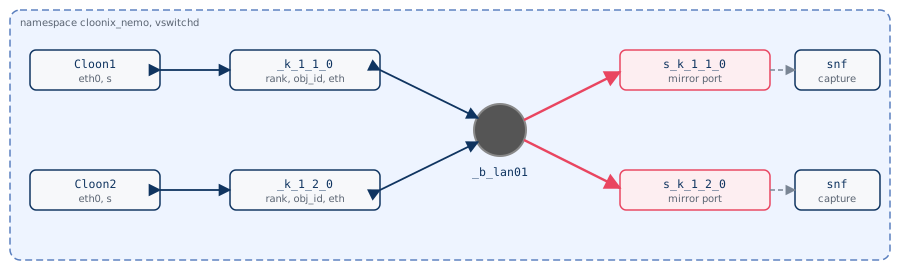
One bridge per lan; each interface of a guest is one port of it, and an interface made capturable has a second port, its mirror, read by one cloonix-ovs-snf each.
17.2. Looking at it
cloonix cli nemo add kvm Cloon1 ram=2000 cpu=2 eth=3 trixie.qcow2
cloonix cli nemo add kvm Cloon2 ram=2000 cpu=2 eth=3 trixie.qcow2
cloonix cli nemo plug Cloon1 eth0 lan01
cloonix cli nemo plug Cloon2 eth0 lan01
cloonix cli nemo cnf Cloon1 eth0 sniff=on
cloonix cli nemo cnf Cloon2 eth0 sniff=on
~$ ip netns list
cloonix_nemo

~$ cloonix cli nemo dump ovs-vsctl show
099c0660-6111-4b0f-b3fc-6dae7138bf19
    Bridge _b_lan01
        Port s_k_1_2_0
            Interface s_k_1_2_0
        Port _b_lan01
            Interface _b_lan01
                type: internal
        Port _k_1_2_0
            Interface _k_1_2_0
        Port s_k_1_1_0
            Interface s_k_1_1_0
        Port _k_1_1_0
            Interface _k_1_1_0
_k_1_1_0 is eth0 of Cloon1 on nemo, s_k_1_1_0 its mirror. The interfaces from the host, by the name of the namespace:
sudo ip netns exec cloonix_nemo ip link
sudo ip netns exec cloonix_nemo ip addr
or by the pid of a process inside it:
pgrep -f "cloonix-ovsdb-server.*nemo"
sudo nsenter --net=/proc/<pid>/ns/net ip link
The ovs database is reached by its socket in the work directory; dump ovs-vsctl fills it in, a cloonix-ovs-vsctl typed by hand does not.
In the toy the ovs binaries are inside the container, which ./nemocmd shell enters.
17.3. When a capture is empty
cloonix cli nemo dump ovs-vsctl list Mirror no row: the snf port receives floods only
User documentation ‹ 16. Recipes › 18. Building the guest file-systems