Developer documentation ‹ Developer documentation › 2. The logic behind the verbs
1. The ways in
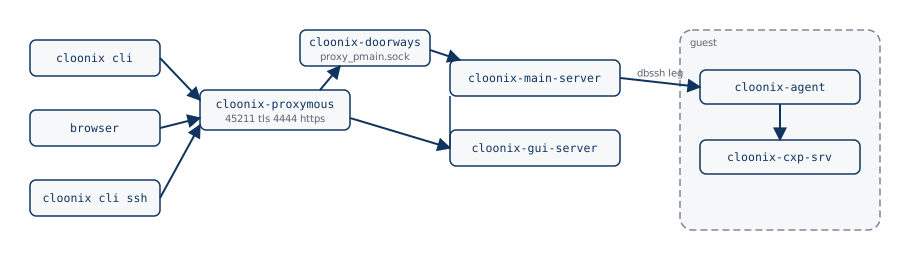
Three transports, ending in the same place: cloonix-main-server is the only process that changes the topology. Everything is multiplexed: one tcp port carries the commands and every conversation with every guest, one byte pipe per guest carries every session into it.
1.1. The cloonix client
Every verb speaks the doors protocol over cloonix_port. The tcp socket is bound by cloonix-proxymous, in the bundle as in the toy: doorways binds no tcp port at all, doorways_sock_server() in lib_io_clownix listens on proxy_pmain.sock and its port argument is not used. A frame is a 48 byte header and a payload; two header fields do the multiplexing:
type        doors_type_switch   a command for the switch, served first
            doors_type_dbssh    a leg into a guest
                                (vnc and openssh keep their numbers and
                                are answered link_ko; nothing sends them)
dido_llid   which conversation the frame belongs to
Twenty shells, a file copy and a dump json at once are twenty-two llids on one socket. Each frame carries an hmac-sha256 keyed with cloonix_passwd; cloonix-doorways checks it and closes without a word on a mismatch, which the client reports as a possible wrong password. cloonix-proxymous stands in front on the public address, ends the tls, and relays the bytes to doorways over proxy_pmain.sock, framing untouched and unread: one tcp connection is one unix connection, both ways.
The leg request carries the wire version of the client, wire=<n>. check_wire_version in doorways/src/llid_traffic.c logs a difference, with the guest the leg goes into, once per distinct version and lets every leg through; from 76 the numbering only grows, so a difference is a hint for a broken interface, never a gate.
A demo is the same client, running where it was typed.
1.2. The web port
https ends at proxymous, which hands the plaintext to proxy_pjsweb.sock. The gui server asks http basic credentials on it, the net name and cloonix_passwd. Every request has its Origin compared with its Host; no Origin means no browser and is let through. What the browser asks becomes rpc to the main server over proxy_pmain.sock.
1.3. Into a guest
The client opens a doors_type_dbssh leg naming a guest and a cookie:
DBSSH_CLI_DOORS_REQ name=<vm> cookie=0000cxp wire=<n>
doorways looks the name up and joins the leg to the agent socket of that guest. The cookie is kept in the format; its value no longer selects anything, the ssh daemon that once shared the pipe being gone. The bytes enter the guest by a unix socket given to qemu as a chardev, seen as /dev/virtio-ports/net.cloon.0, or by a socket bind-mounted into a container. cloonix-agent passes them to /cloonixmnt/tmp/unix_cloonix_cxp_sock, where cloonix-cxp-srv runs the command, opens a pty, or serves a transfer. The opcodes are in glob_include/cxp_wire.h, compiled by the linux, windows and freebsd servers alike:
EXEC PTY PUT GET PUTTREE GETTREE LIST
One operation per connection; an unknown opcode is answered unexpected first opcode N.
The two consoles of the canvas take one route: cloonix-dtach attaches to a session on the host, the qemu stdio console wrapped in dtach at launch for a kvm, and a session that cloonix-suid-power forks on demand running crun exec for a cnt. Only the fork is privileged; the socket is chowned to the user and left 0600.
1.4. What runs on the server, and as whom
A demo played from the canvas: the gui server resolves the name under /usr/share/cloonix/demos, reads the file from its own disk, hands the text to proxymous, which runs it on the host as the user of the net. Nothing a browser sent is executed.
cloonix-suid-power is the only root process of a net: installed setuid, drops to the caller's uid at boot, takes root per request, speaks a fixed vocabulary. There is no "run this command" among its verbs.
Everything a browser sends that becomes part of a path goes through web_name_ok: a name, not a path. /files/save, which once wrote a browser-supplied body into the share, answers nothing any more; the lsh local shell is gone; no route accepts a programme.
Developer documentation ‹ Developer documentation › 2. The logic behind the verbs