Developer documentation ‹ 15. Things that could be added next
16. Things set aside: systemd inside the toy
One service was given up on purpose: systemd as the first process of a container, when that container runs inside the toy. In the bundle it works as before. This chapter says what the service is, why it went, and which architecture would bring it back. It assumes nothing about cgroups; the chapter A starved proxymous tells how the subject came up.
16.1. What the service is
A cloonix container normally runs no init: cloonixsbininit starts the agent and a syslog daemon, and that is all. One option asks for the init of the image:
cloonix cli nemo add cnt c1 eth=1 trixie_systemd startup_env="CLOONIX_WITH_SYSTEMD=1"
cloonix cli nemo ssh c1 "cat /proc/1/comm"
systemd
With it, systemctl start <service> works in the container as on a real machine. In a toy the same command now gives:
cloonix cli nemo ssh c1 "cat /proc/1/comm"
cloonixsbininit
cloonix cli nemo ssh c1 "cat /run/cloonix_no_systemd"
CLOONIX_WITH_SYSTEMD=1 asked, but /sys/fs/cgroup is not writable here: systemd cannot run, started without it
16.2. Four notions, in plain words
A cgroup is a folder the linux kernel keeps for a group of processes. Every process is in exactly one. The folders are visible as directories under /sys/fs/cgroup, and they nest like directories do. The kernel uses them to count and to share: so much memory for this group, so much cpu for that one. cat /proc/self/cgroup prints the folder of the shell that runs it.
Writing in a cgroup means creating sub-folders in it and moving processes between them. The folders belong to users like files do. Almost all of them belong to root.
Delegation is root handing one folder to a plain user: "this one is yours, make what you want below it". On a machine with systemd, each logged-in user has a small systemd of their own, the user manager, and it can create such a folder on request. The request travels on the user bus, a socket at /run/user/<uid>/bus. A machine without systemd (alpine with openrc) has no user manager, no user bus, and nobody to ask.
systemd as pid 1 needs to write. Its way of keeping track of services is to make one sub-folder per service. With no folder it may write in, it stops at boot and never answers.
16.3. Why it went
The toy is cloonix run by a plain user, with no root at all. Until september 2026 the toy asked the user manager for a delegated folder, crun-nemo.scope, and lived in it. A container of the toy saw that folder as its /sys/fs/cgroup, could write in it, and systemd started.
The cost appeared under load on one kernel. cloonix-proxymous, the half of the net that must stay on the machine, was not in that folder. The kernel gave the cpus to the busy folder and left proxymous, alone in a quiet one, without any for up to 35 seconds. A net that loses its proxymous for 30 seconds destroys itself. Keeping the whole net in one folder removed the problem, and the only folder available to everybody without asking is the one the shell is already in, which belongs to root: nothing can be written there, so systemd in a container of the toy went.
It can still be asked for, on a host where it matters more than the risk:
CLOONIX_TOY_CGROUPM=systemd ./nemocmd start
16.4. The architecture that would bring it back
Both wishes hold together if one delegated folder contains the whole toy, proxymous included: one folder, so the kernel shares between processes and starves none; delegated, so systemd in a container can write.
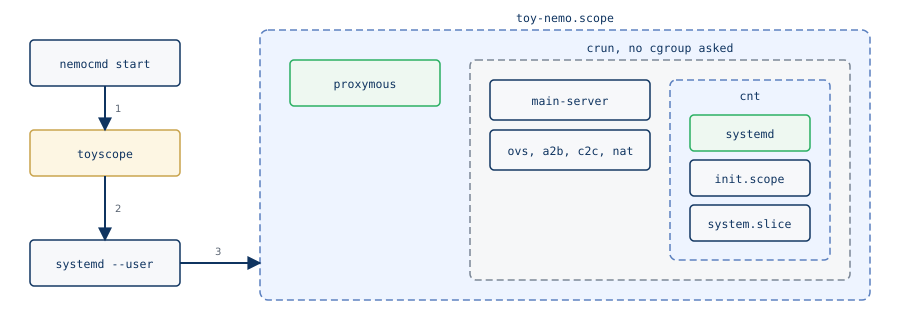
The figure reads in three steps.
nemocmd start runs a small new binary first, called here toyscope, shipped in the toy like the rest.
toyscope speaks to the user manager on the user bus and asks for a new delegated folder, toy-nemo.scope, with itself as the first member. This is what the host command systemd-run --user --scope -p Delegate=yes does; cloonix does not call host commands, so the request is made by toyscope itself.
The user manager creates the folder and moves toyscope in.
From then on everything is inheritance: a process is born in the folder of its parent. toyscope starts proxymous, then crun with --cgroup-manager=disabled, so that crun asks for nothing and stays where it is. The servers, the switch, the guests and proxymous are all in toy-nemo.scope. A container of the toy sees that folder as its /sys/fs/cgroup, the mkdir probe of cloonixsbininit succeeds, and systemd starts.
Where there is no user bus, toyscope starts the same two things without asking anybody, the probe fails, and the container comes up without systemd with its reason written, exactly as today. The behaviour then differs between machines only where the machines differ.
16.5. What exists, what is to write, what is to verify
Exists:
libsystemd is already in cloonfs: crun is built with --enable-systemd and needs it (build_tools/build_cloonfs, libsystemd-dev). Its sd-bus functions are the bus client.
setup.sh already starts proxymous and crun in that order and already has the disabled path.
The probe and the fallback in cloonixsbininit, and the sub test that reads /run/cloonix_no_systemd.
To write:
toyscope, about a hundred lines of C: open the user bus, call StartTransientUnit of org.freedesktop.systemd1.Manager with the properties PIDs (its own pid) and Delegate (true), wait for the job to end, then exec what it was given. No bus: exec at once.
Its place in toy_targz/create_toy_targz.sh and one line of setup.sh.
The stop: a scope ends when its last process ends, nothing to add.
To verify on real machines before relying on it:
That the move is allowed. The shell is in a folder of root (session-<n>.scope); moving a process from there into a folder of the user crosses a border only root may cross. systemd-run --user --scope succeeds from such a shell on current systemd, the user manager asking the system manager for the move. To check on each of the six systemd machines:
systemd-run --user --scope -p Delegate=yes cat /proc/self/cgroupThe answer must name a folder under user@<uid>.service.
That systemd in the container accepts a folder that already holds processes. The kernel refuses to give sub-folders their own cpu or memory accounting while their parent holds processes directly. The former layout had the same shape (the servers and the container shared crun-nemo.scope/container) and systemd reached running or degraded there; the sub test sub_systemd_image.py is the check.
That the storm still passes on rocky, with proxymous inside: the stall lines of the chapter A starved proxymous give the answer in one run.
Until those three are seen, the present choice stands: no cgroup of its own for the toy, the same everywhere.
Developer documentation ‹ 15. Things that could be added next