Developer documentation ‹ 12. Writing a demo › 14. A starved proxymous: trixie passes, rocky does not
13. The autotest: the suites in two kvm
Two scripts, one mechanism (autotest_common.sh), the same two kvm:
slow_autotest.sh     the whole non-regression and the endurance, about 3 hours
fast_autotest.sh     a big breakage of a function, aimed at 10 minutes
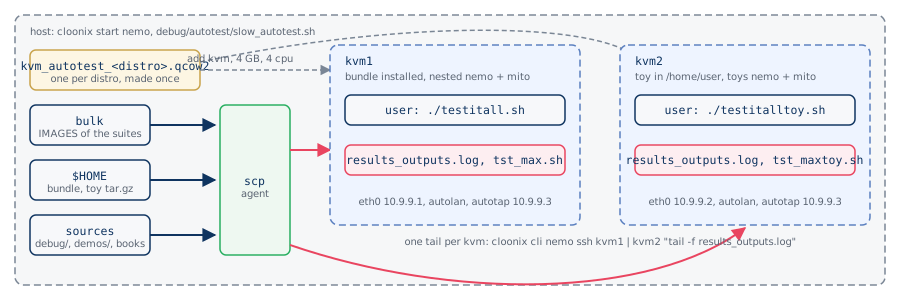
debug/autotest/slow_autotest.sh runs the two non-regression suites of debug/ inside two kvm of the net nemo, so that a delivery is tested on a machine that has nothing of the development host: testitall.sh on the bundle in kvm1, testitalltoy.sh on the toy in kvm2, each as the user user, each writing its logs in its /home/user; then the endurance on each, tst_max.sh in kvm1, tst_maxtoy.sh in kvm2. No nat: the one interface of each kvm is on the lan autolan with the tap autotap of the host, for the browser of the host only (The web of the nets under test).
cd debug/autotest
./kvm_autotest_trixie.sh                        once: bulk/kvm_autotest_trixie.qcow2
./slow_autotest.sh                              kvm_autotest_trixie.qcow2
./slow_autotest.sh rocky                        kvm_autotest_rocky.qcow2
./fast_autotest.sh                              the same machines
cloonix cli nemo ssh kvm1 "tail -f /home/user/results_outputs.log"
cloonix cli nemo ssh kvm2 "tail -f /home/user/results_outputs.log"
cloonix cli nemo ssh kvm1 "tail -f /home/user/tst_max_output.log"
cloonix cli nemo ssh kvm2 "tail -f /home/user/tst_max_output.log"
13.1. The machines, made once
The autotest must run on every distro cloonix supports, so there is one machine per distro, kvm_autotest_<distro>.qcow2, for trixie, alpine, arch, fedora44, resolute, rocky and tumbleweed. Both scripts take the distro as its argument, trixie by default, and refuses any other name.
debug/autotest/kvm_autotest_<distro>.sh boots the base <distro>.qcow2 on nemo with a nat to the mirror, as kvm_python_trixie.sh does, and writes into it everything the suites ask of the machine; debug/autotest/doitall.sh --all runs the seven. The mechanics and what every machine gets are in kvm_autotest_common.sh; each kvm_autotest_<distro>.sh holds only its package command and the mechanisms its init and syslog need:
python3 gcc, a libc-dev, sudo       the client and the tests, check_wire.sh
newuidmap (uidmap, shadow...)       the second uid mapping of the toy
rsyslog                             /var/log/syslog, read by demo_test.py: Debian's
                                    writes it, elsewhere rsyslog.d adds the file, 0644,
                                    and journald forwards where rsyslog reads /dev/log;
                                    arch has no rsyslog, syslog-ng writes the file
dbus                                the buses crun's cgroup manager opens: the system
                                    one for a cnf cpu= ram= of the bundle, the user one
                                    for the toy's own container
user                                created when the base has none
/etc/sudoers.d/user                 passwordless sudo, fail_spider.sh and the tap check use it
/etc/subuid /etc/subgid             user:100000:65536
linger for user                     user@<uid> and its bus, with no login (systemd)
kvm, vhost-net, tun                 mode 0666, the nested kvm: udev rules, or a local.d
                                    script on alpine (openrc, mdev)
/etc/hosts                          the hostname, so sudo says nothing
/var/lib/cloonix/bulk               mode 777
no firewall                         firewalld, ufw, nftables, iptables: stopped, disabled, masked, flushed
A machine is kept only if every tool the suites and the runner call answers (TOOLS in kvm_autotest_common.sh: tar, python3, gcc with a libc to link, newuidmap, setsid, pgrep, ip ...) and the autotest asks the same of each kvm before pushing anything to it; iperf3 is optional, the tap flow is measured only with it.
RHEL kernels (fedora44, rocky) ship no mac80211_hwsim: the wifi sub test and the wifi demos are skipped there, each saying so, as the user book lists that module among the optional ones.
The toy asks for no cgroup of its own (the toy chapter of the user book says why), so a user bus is no longer needed by it on any machine; the runner still says when there is none, as alpine has no user@. The systemd image sub test, in a toy, sees the starter fall back and prints its reason instead of failing; CLOONIX_TOY_CGROUPM=systemd ./slow_autotest.sh <distro> runs the toys the old way. The nat, the mirror and the package manager are not used again once the machine is made.
13.2. What the host needs at a run
${HOME}/cloonix-bundle.tar.gz    the newest is taken
${HOME}/cloonix-toy.tar.gz       the newest is taken
/var/lib/cloonix/bulk/kvm_autotest_<distro>.qcow2   the machine of the distro asked
trixie.qcow2 trixie perf_trixie        the images the suites name, copied
flow_trixie trixie_systemd             into the bulk of each kvm
nested kvm                             the kvm of the inner nets
sudo                                   the address of autotap
The image list is IMAGES in the script; AUTOTEST_IMAGES in the environment replaces it. A container image goes to the kvm as <image>.tar.gz, the form the server extracts at the first add cnt: taken as it is when bulk holds that form, packed from the directory otherwise, as cnt_common_pack does, inside unshare --map-auto since the files belong to the subuids of whoever built it, or with sudo when the host has no subuid line.
DEMO_IMAGES (AUTOTEST_DEMO_IMAGES replaces it) names the images of the demos, so that demo_test.py runs nearly every demo in the kvm instead of skipping it; one that bulk does not hold warns, and its demo skips. Left out: ebpf_trixie (XDP asks for the initial user namespace), python_trixie.qcow2 (phy and realnet, a third level of kvm) and the freebsd, windows and cisco disks.
Each kvm gets the source tree in /home/user/sources, .git and the targz stores left out, and those images in its bulk. Then kvm1 gets the bundle installed with install_cloonfs and kvm2 the toy tarball in /home/user, where testitalltoy.sh looks for it.
13.3. The run
autotest_run.sh, written by the script into /home/user of each kvm and started there with setsid -f as user, so the session of the agent may end, with XDG_RUNTIME_DIR and DBUS_SESSION_BUS_ADDRESS naming the user bus, since a su opens no session. The tests stop a sniff --count or a trafgen with SIGINT, and a signal ignored or blocked anywhere up the chain is inherited by every process of the suite, which a shell cannot undo: the runner is exec'd through autotest_launch.py, a python that puts the dispositions and the mask back to default, and setsid -f rather than &, since a job a non-interactive shell puts in the background gets SIGINT ignored.
The runner empties /var/log/syslog, runs the suite with TESTITALL_NO_ENDURANCE=1, which stops testitall.sh after phase 8 with TESTITALL OK, and writes, in /home/user:
results_outputs.log   SigIgn and SigBlk the suite runs with, the suite's output,
                      a summary at its end: verdict, duration, phases reached,
                      checks ok, demos skipped, the FAILED lines, KERR count;
                      every minute a time stamp line of *progress.py*: the clock,
                      the time elapsed against the expected total, the phase, the
                      demo that runs; under every phase title one line of the
                      machine: free memory, load, disk left
kerr1_outputs.log     the KERR lines of /var/log/syslog during the suite, as they come;
                      in kvm2 also those of the two toys' own syslogs
tst_max_output.log    when the suite passed, the endurance: tst_max.sh in kvm1,
                      tst_maxtoy.sh in kvm2, SOAK_MAX_LIVE=20 SOAK_MAX_LIVE_KVM=2
                      for the 4 GB of the kvm
kerr2_outputs.log     the KERR lines during the endurance, syslog emptied
                      again between the two
tst_maxtoy.sh starts the toys with testitalltoy.sh start and points soak.py at them with its env: the toy's client, and the work zones and syslogs inside the rootfs of each net, where the soak reads what a dead container left. When a suite fails, the logs the toy names (crun.log, the init-starter log) and the last 200 lines of kerr1_outputs.log follow the summary: a toy's proxymous logs to the machine's syslog, so only the merged file shows it beside the two nets. The sizes of tst_max.sh are those of the development host, 45 objects alive and 25 kvm of 1 GB; the two exports size it for kvm1. RAM and CPU of the two machines are at the top of autotest_common.sh.
13.4. The web of the nets under test
Once the two kvm answer, web_lan adds the tap autotap, cables it and eth0 of each kvm to autolan, and gives the addresses:
kvm1 eth0   10.9.9.1/24     https://10.9.9.1:4444 nemo, https://10.9.9.1:4454 mito
kvm2 eth0   10.9.9.2/24     https://10.9.9.2:4444 nemo, https://10.9.9.2:4454 mito
autotap     10.9.9.3/24     on the host, with sudo
user nemo password nemoclown, mito and mitoclown. No route is added: a machine still has no internet, the suites run as before. A machine built before the builder took the firewall out gets the same FIREWALL_OFF there, and one that does not answer the ping of the host has its eth0 and its rules printed. A failure in web_lan warns and the suites start all the same.
The machines are left running, pass or fail. To start again, run the script again: it kills nemo and rebuilds the pair.
13.5. The fast autotest
fast_autotest.sh prepares the same two kvm with only trixie.qcow2, trixie and perf_trixie in their bulk, no demo image, and runs in each debug/testfast.sh, no endurance: in kvm1 on the bundle after testitall.sh start, in kvm2 on the toy after testitalltoy.sh start:
2. testitall.py      every item of cloonix once, with its sniffs and flows
3. SUBS              the short sub tests, those that boot no kvm of their own
4. two demos         cloonix/cnt.py and cloonix/cntwifi.py
The same logs as the slow one, results_outputs.log and kerr1_outputs.log. Before its summary the log has the table of the duration of every step, the longest first; the summary adds the preparation on the host side and the total. The budget is held by taking the longest steps out of SUBS in testfast.sh. Left to the slow autotest: the doc checks, the kvm variants, testfailures.py, the flows above their limit, the storms, most demos and the endurance.
Developer documentation ‹ 12. Writing a demo › 14. A starved proxymous: trixie passes, rocky does not